
TLDR:
Grok Bot is xAI’s always-on AI agent that gets its own persistent cloud computer like a real person would and keeps working after you close your laptop.
It’s the first product to come out of SpaceX acquiring Cursor for $60 billion and being folded it into xAI as Grok Bot shipped days after that deal closed.
It’s genuinely like having an AI teammate that’s always-on working with you. It only hands back control when it gets stuck like with a payment or login screen.
It’s less flexible than open options like Hermes and OpenClaw, but it’s incredibly easy to use and a clear look at the future of work in coordinating teams of agents.
One of the latest AI solutions on the block is Grok Bot, the result of a multi-billion dollar acquisition of Cursor by SpaceX. I only got around to using it this past week and I was so impressed that I decided to make a post about it.
I’ve already covered OpenClaw and Hermes in the past, which are open-source agentic frameworks. The beauty of them is that they are flexible allowing you to set them up on local hardware or on the cloud, and with any AI model you want! However that flexibility is also their drawback in terms of complexity and ease-of-use, which is where Grok Bot shines.
If this post resonates with you and you enjoy the content then please share it with a friend and get rewarded for doing so!

This blog goes out weekly to over 20,000 subscribers. Please message me if you’re interested in sponsorships or partnerships.
Grok Bot
Grok Bot is xAI's always-on AI agent, a persistent "teammate" that runs on its own cloud computer, signs into the tools and websites you already use, and keeps working on multi-step tasks 24/7 whether or not you're at your own computer.
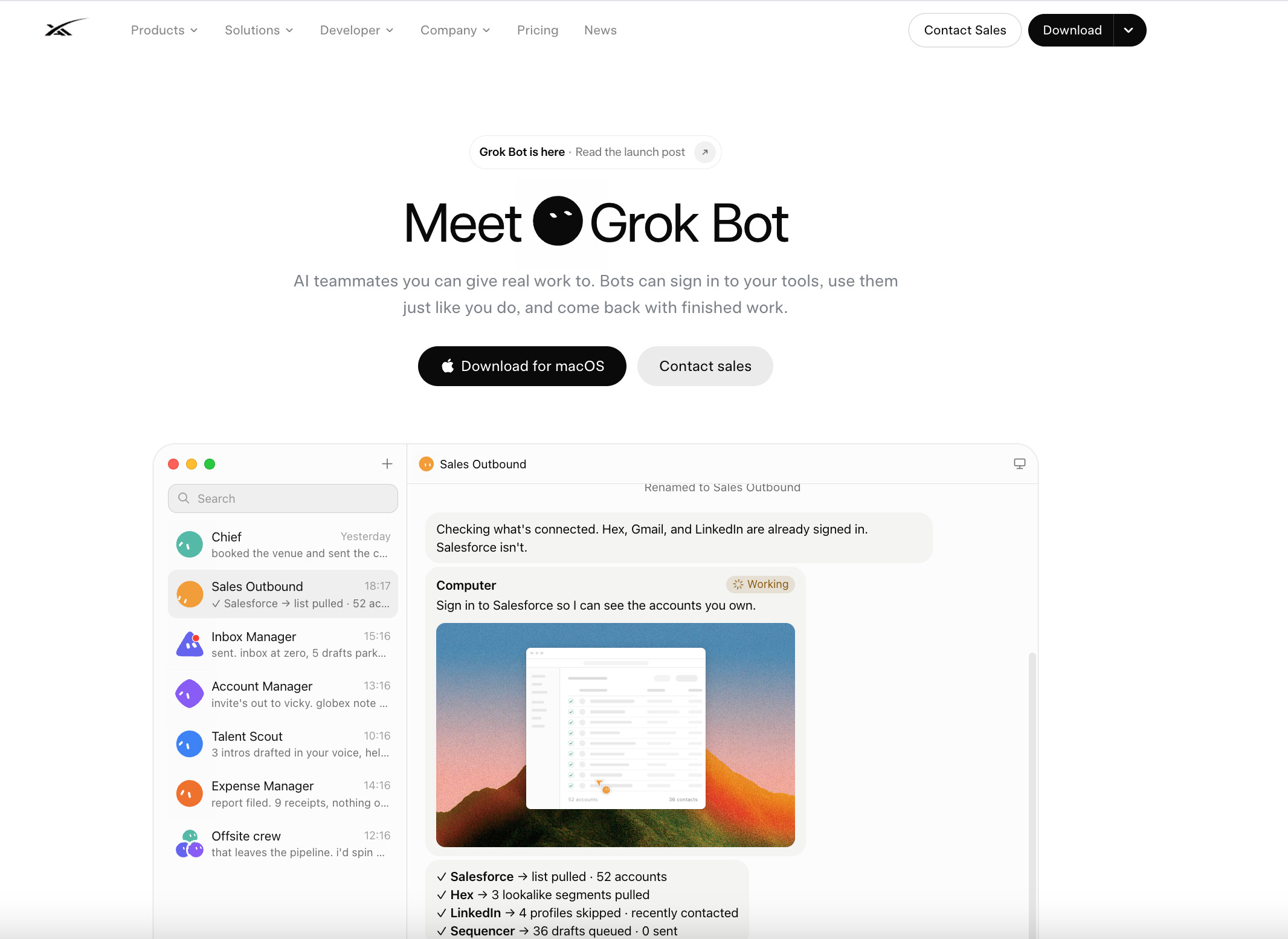
In essence, Grok Bot is the closed-source version of OpenClaw and Hermes, both of which I’ve covered before in this blog.

As a reminder, OpenClaw and Hermes are open-source, self-hosted agent frameworks that you install yourself and point at whichever model you want to run them with. While Grok Bot is xAI’s fully managed take on the same idea, there’s no model choice but it has a cloud computer and browser hand-off built into it from the start.

As I say, this is an AI agent with its own computer, not a chat window, not a browser extension, an actual persistent computer in the cloud that it operates the way you’d operate yours. This key fact is what makes Grok Bot unique and different to using something like Claude or ChatGPT directly.
Grok Bot launched on August 11th with xAI positioning it around business workflows specifically, like sales outbound, marketing campaigns, expense management, bug fixes, and CRM updates, which are all tasks with real multi-step structures rather than one-shot questions.
Grok Bot takes the tasks you give it and builds automations, making judgement calls mid-task and trying a different approach when the first one doesn’t work rather than stopping and waiting for your input.
A typical AI chatbot session is task-oriented where you describe a job and it works through it and the relationship resets around each task. Grok Bot persists instead, the computer keeps running, the bot keeps its context, and you can come back to it later the same way you’d check in on a teammate.
It doesn’t use the smartest model under the hood, and it’s noticeably less flexible than open alternatives like OpenClaw and Hermes, but in practice it’s easier to get setup and start solving real problems.
SpaceX’s acquisition of Cursor
SpaceX IPO’d earlier this year on June 12th, and at today’s stock price the company represents the 9th most valuable asset in the world being worth almost $2tn.
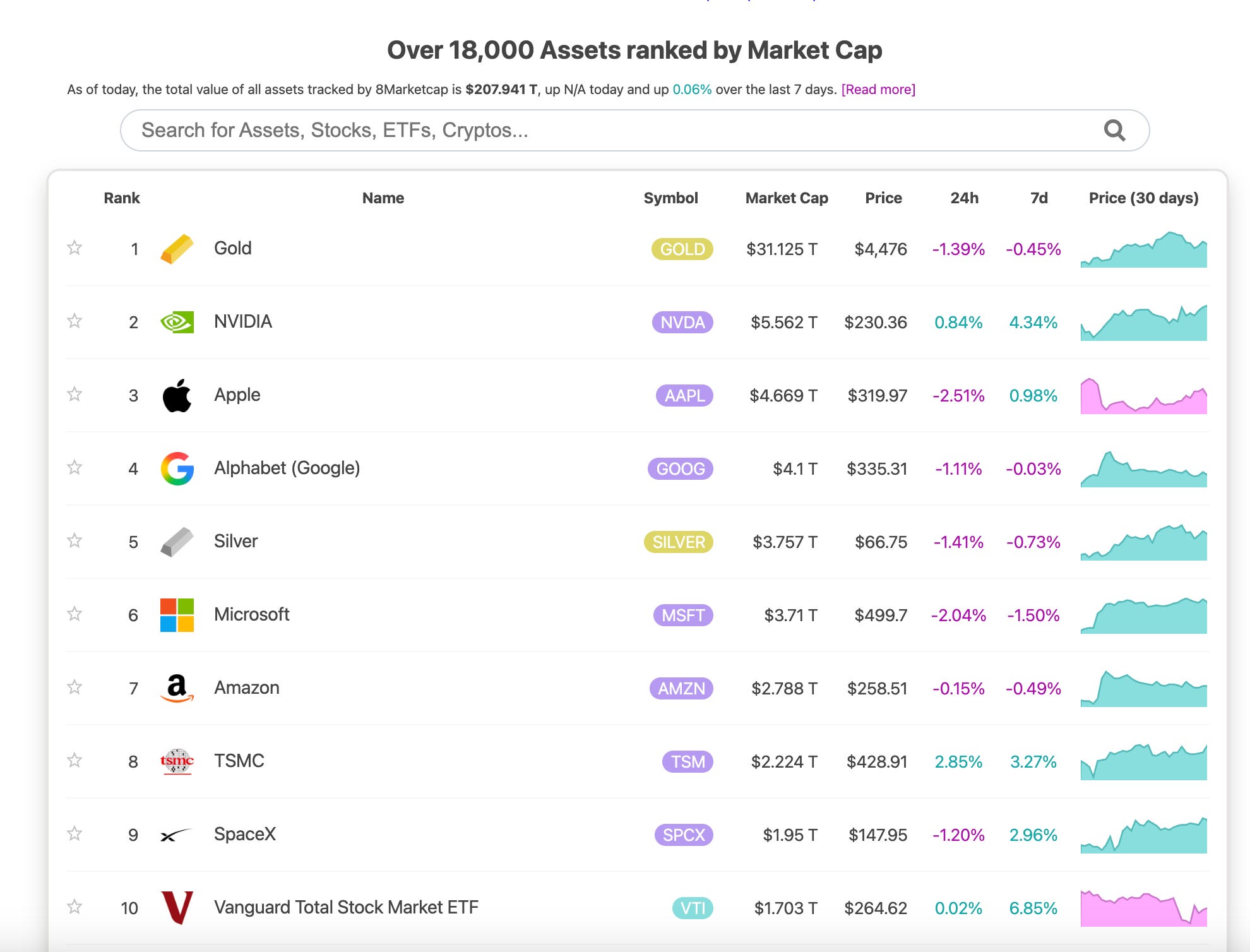
Before the IPO its owner Elon Musk had already merged his AI company xAI into it to form the sub-entity SpaceXAI. This merger gave SpaceX a massive GPU cluster in Memphis called “Colossus” reportedly running around 200,000 Nvidia chips with plans to scale toward a million, along with xAI’s Grok models and users.
Soon after the IPO on June 16th, SpaceX agreed to acquire Cursor, the AI coding startup, for $60 billion in an all-stock deal - one of the largest acquisitions of a venture-backed startup ever. I’ve already written about Cursor before however that was early last year and their offerings have evolved a lot since.

The Cursor deal closed August 14th and the combined company now benefits from xAI’s models, Cursor’s developer tools and user base, and SpaceX’s massive compute clusters, all under one roof!
Grok Bot launched just days after the Cursor acquisition closed. It’s genuinely the first product born from this entire merger, followed by xAI recently shipped Grok 4.6, their latest AI model fine-tuned in part on Cursor’s own developer session data.
Using Grok Bot
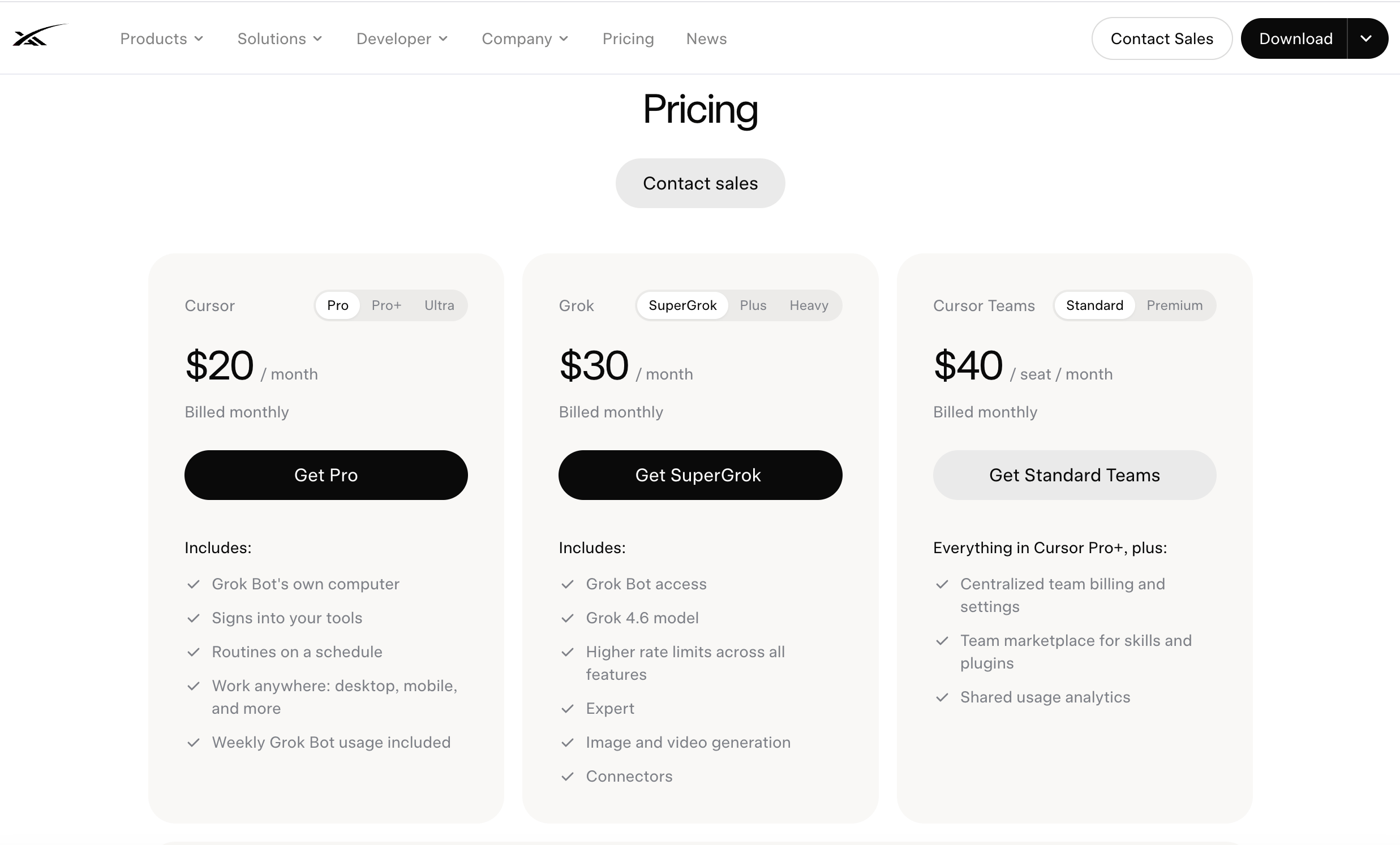
Getting started with Grok Bot is incredibly simple, although it’s not free and will require you getting at subscription to get started.
At launch Grok Bot was gated behind pricier tiers of up to $300 with SuperGrok Heavy. But just two weeks later xAI opened it to every individual SuperGrok and paid Cursor plan starting at $20 a month - it’s still a little confusing to navigate all of their plans but I’m sure they’ll be simplified soon.
Once you’ve downloaded the Grok Bot software you’ll be invited to create a new Bot. You can give it a name and a colourful icon to represent it. For the sake of this tutorial I created a new bot as you can see below. It has a purple bot icon and already has the knowledge from previous bots I’ve created but is essentially a fresh start.
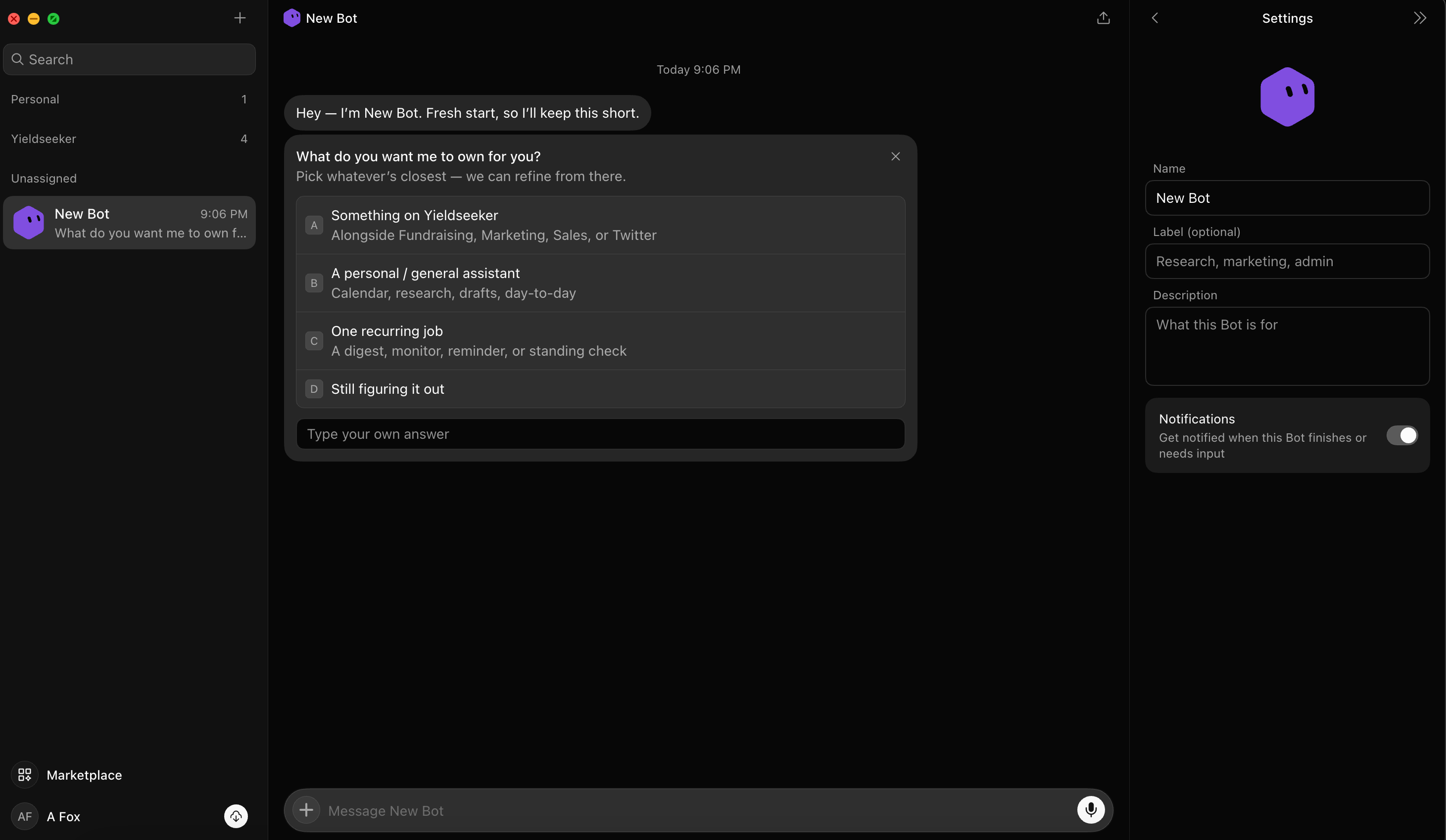
To keep things simple I decided to make it into a news agent that regularly gives me daily crypto news. By simply renaming it to “Crypto News”, it already got some idea of what job it should be doing and immediately asked me for more specific detail on the type of news it should be watching out for!
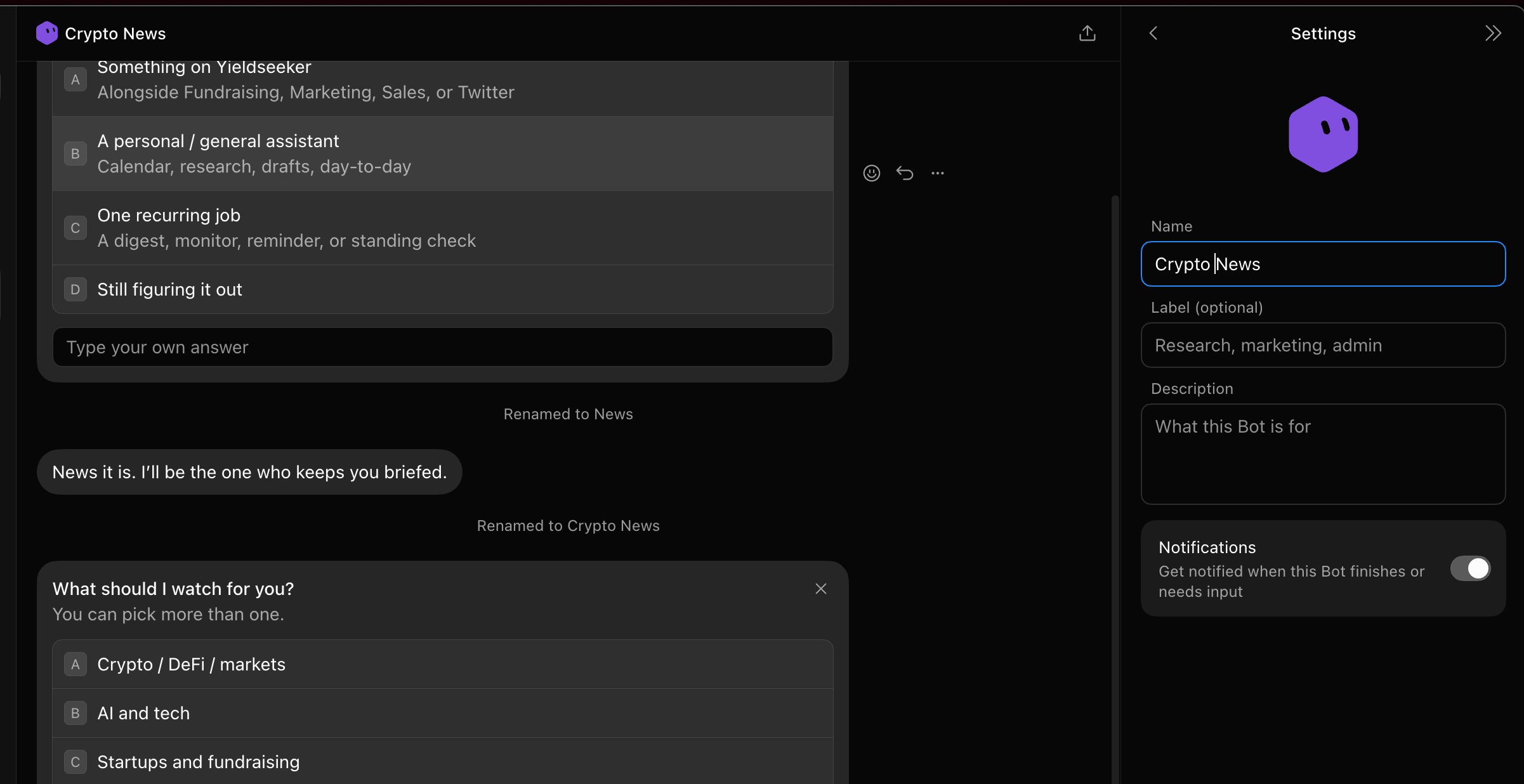
In this case I went with “both A and B” for Crypt/DeFi/markets plus AI and Tech, and it immediately and pro-actively gave a few different options on the frequency of the news it could give me.
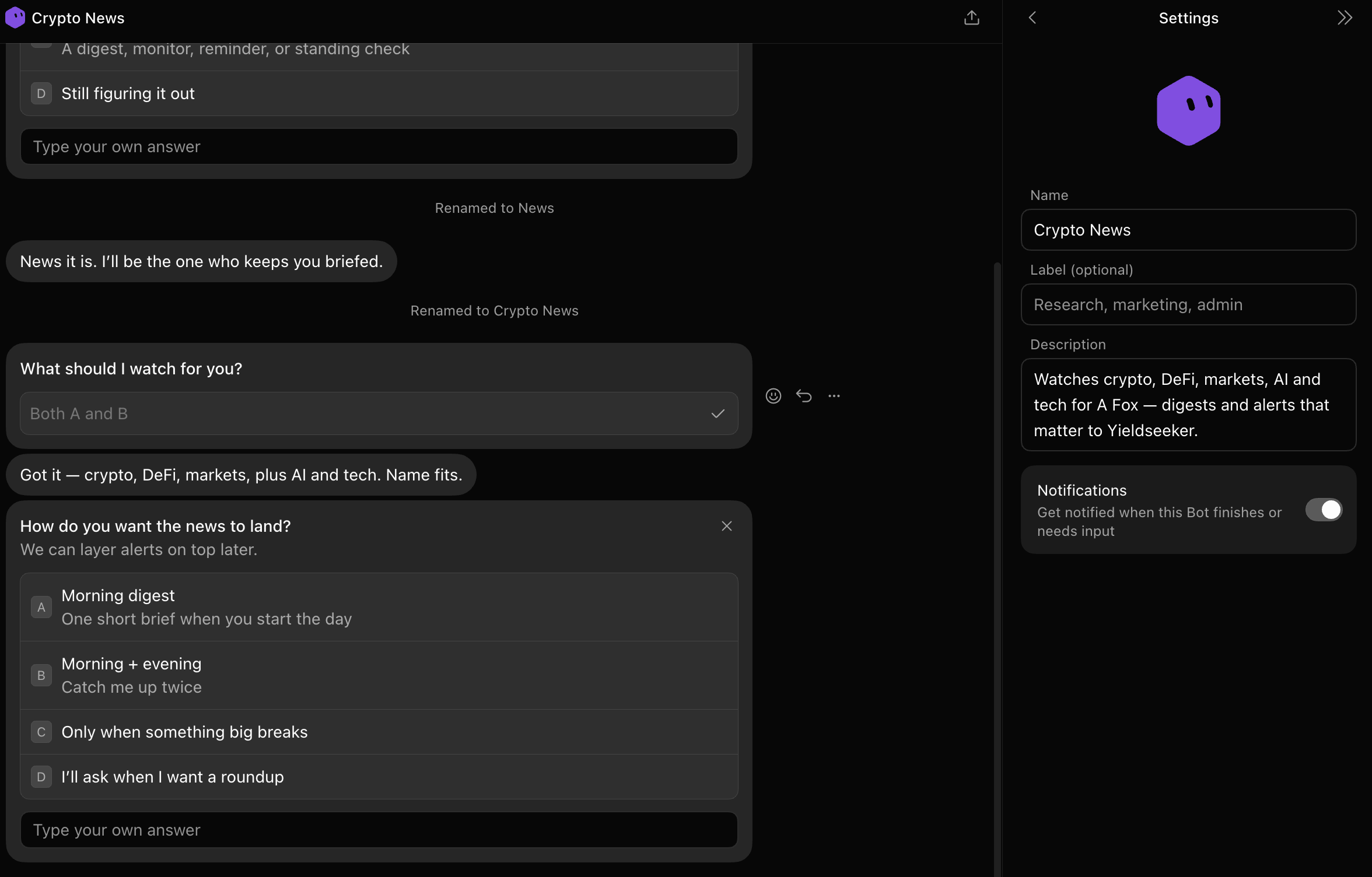
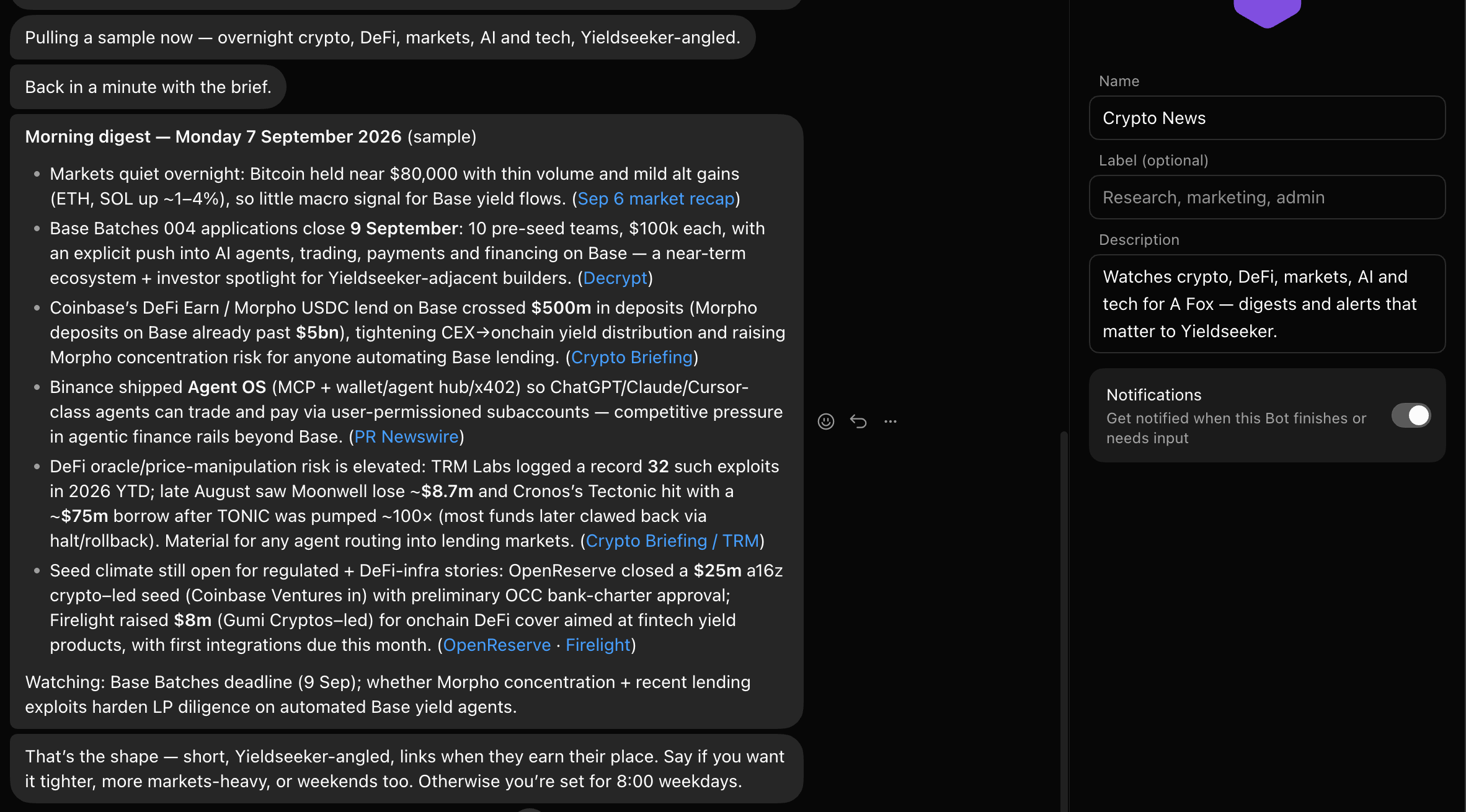
Here I went with a “morning digest” and that was it! The bot figured out its role just through the name I gave it and me answering a few questions, and it kicked off the first example of a news digest!
Another really powerful feature in Grok Bot is that when a bot genuinely can’t get past something, a login screen, a CAPTCHA, a payment confirmation, or similar, it opens its own browser window with a “sign in, then hand it back” prompt. You authenticate, click done and it will resume on its own from where it left off.
Moreover you can get separate bots to sit together within the same chat. For example I have another bot that helps me with my X account that I called “Twitter”. Below you can see that I added the two bots into a Group Chat to get them to communicate together to help me suggest topics I could be posting about on X.
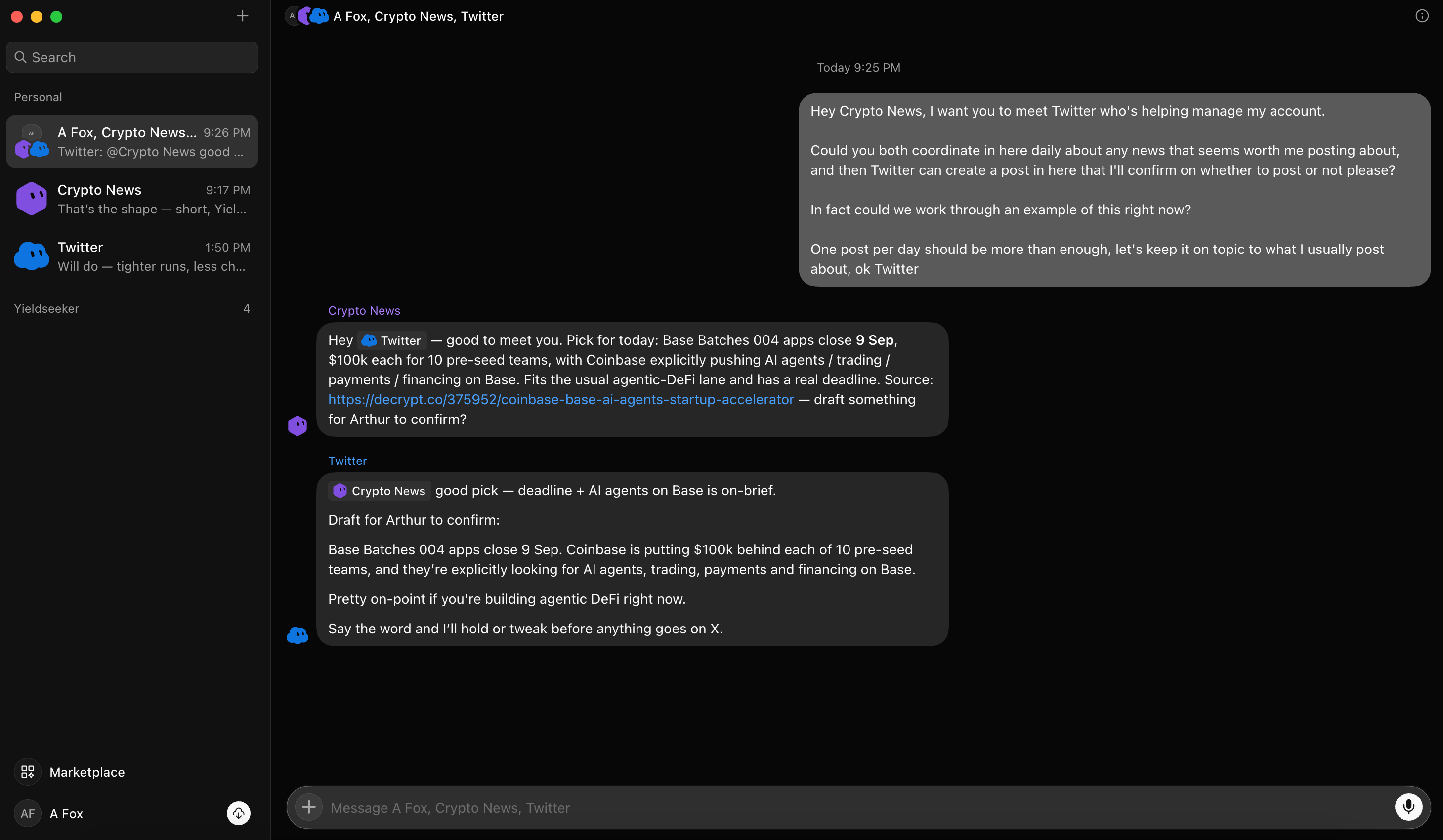
Thanks to this Group Chat feature there’s also a common paradigm within Grok Bot of having a “Chief of Staff” bot that talks with all of your and reports back on what they are doing.
This allows one orchestrator bot to direct specialist bots underneath it, so you’re managing a single bot who then manages and coordinates these other bots for you.
This feels like a glimpse into the future of work as you direct a leader bot who works with all the other bots to make sure company tasks are getting done throughout the day. However this setup also generates more complexity and I personally haven’t seen much need for it yet, but I might as my bot count grows.
Open vs Closed
I’ve discussed the most popular open agentic frameworks OpenClaw and Hermes multiple times before. They are both open-source and both allow you to self-host the agent either on a local machine with a local model, or on a VPS with an API key, or some other combination of both.
Since you’re assembling the pieces yourself here, you can build a genuinely better and more tailored setup than Grok Bot offers out of the box. You can even get an agent to swap between AI models mid-way through its work to optimise model usage, and ultimately make some very complex and smart setups.
That flexibility comes at the cost of assembly though. You’re choosing models, wiring up connectors, and maintaining the thing yourself, and often times it will break and not be clear what went wrong.
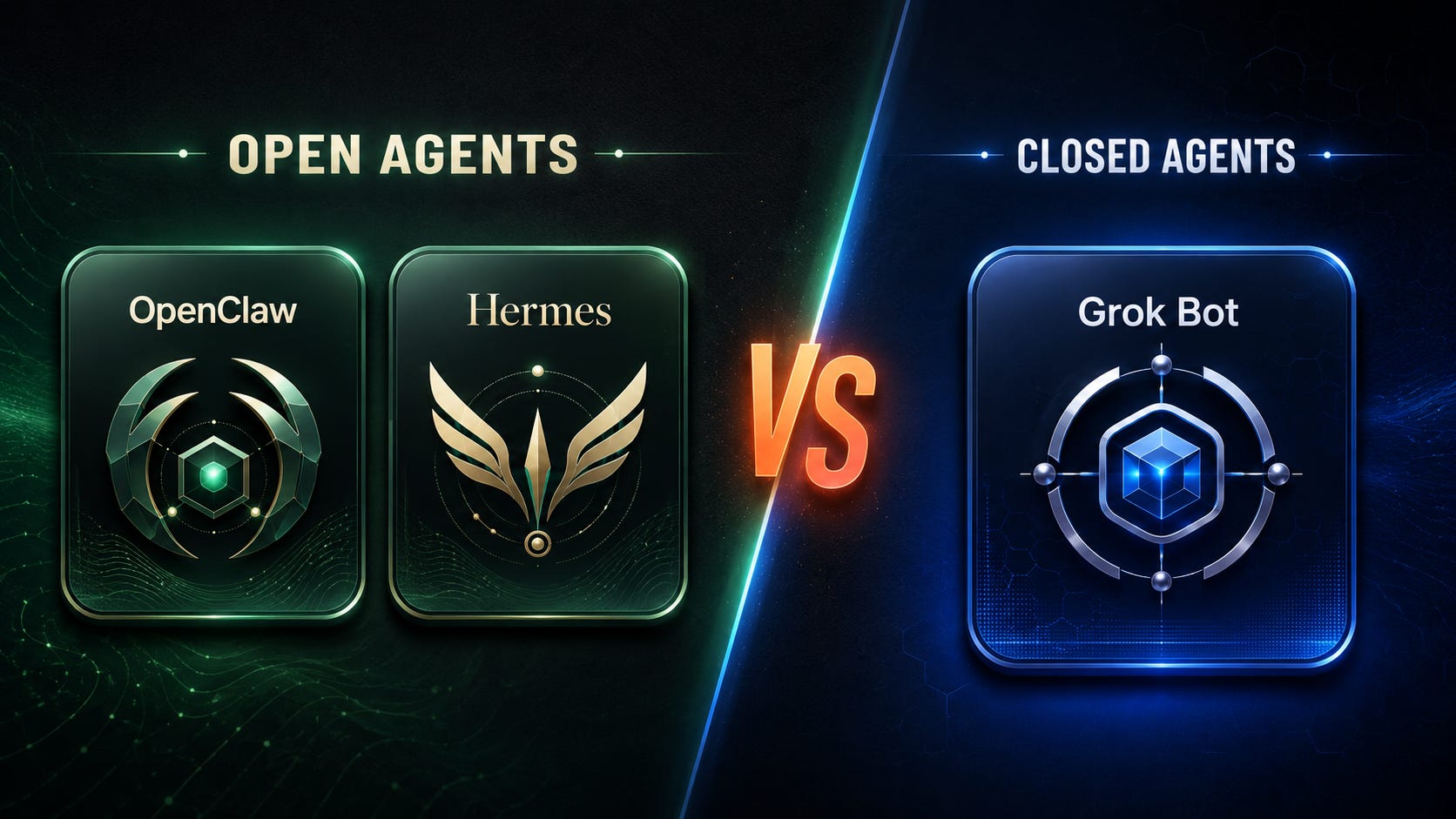
Grok Bot is closed source and therefore gives up all of that choice. You’re locked into xAI’s own models, but in exchange you get something that just works and starts solving real problems with close to zero setup.
Grok Bot has real privacy concerns, as with all closed source AI companies, but if you’re running your OpenClaw or Hermes agent with an API key into a frontier lab as most people do then you face the exact same issues.
While plugging in Claude and ChatGPT models into OpenClaw and Hermes can get you a much smarter agent, Grok Bot’s persistent always-running “teammate” and its bot-to-bot messaging is genuinely distinct and unique.
Before I thought you could make do with just ChatGPT and Claude subscriptions, but now I think it’s worth having a Grok subscription for Grok Bot too!
The beauty of closed source
There are pros and cons to both routes, Apple versus Windows is a useful comparison here. Apple controls the whole stack and gives up the flexibility that Windows and its endless configurations offer, yet that closed-ness is often the actual advantage, with less to configure there’s less to break and more that just works.
The comparison between Grok Bot vs OpenClaw and Hermes is the same type of trade-off in agent form. With Grok Bot you pay for something that just works, while with OpenClaw and Hermes there’s infinite configuration variables and you’re often solving problems that are setup related rather than the task at hand.
There’s no doubt that a top-end Mac Studio running a frontier model locally with Hermes is the most private and smartest agent you can have. But it’s going to cost you thousands of dollars to buy the hardware, it requires reliable Internet, and regular upgrades of Hermes, the model and the hardware. Meanwhile Grok Bot just works.
Importantly this feels like a real early glimpse of where work is heading, where it’s less about doing tasks yourself or babysitting a single chatbot, and more about orchestrating a small team of agents that coordinate among themselves and only come back to you when they genuinely need something - the future’s here!

Whenever you’re ready, these are the main ways I can help you:
Want high crypto returns? Earn up to 14% APY with your own Yieldseeker agent!
Love Web3 & AI? Follow @afoxinweb3 on X for insights!
Entrepreneur using AI? Join our AI community to accelerate your results!