
TLDR:
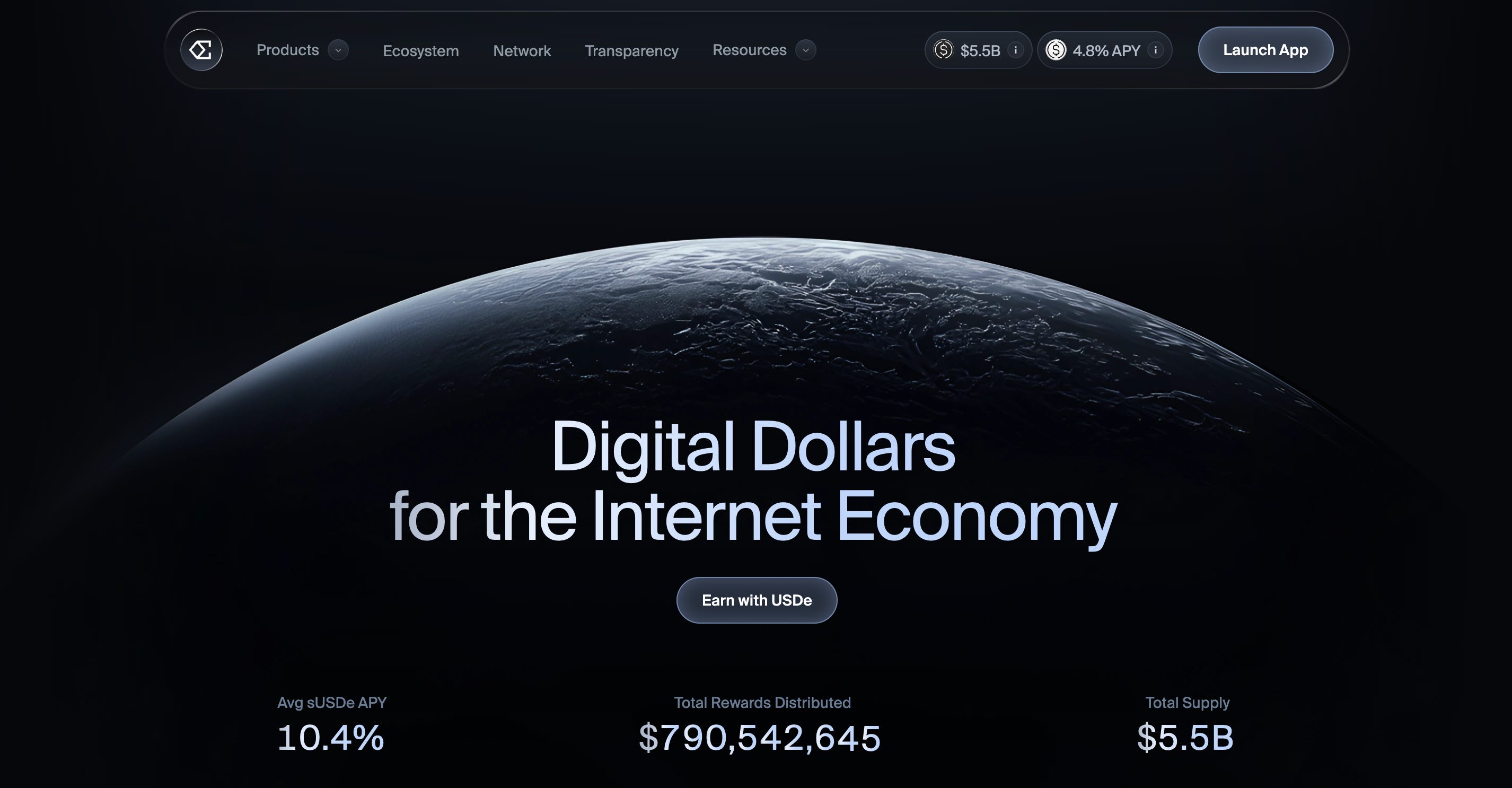
Ethena’s USDe is a “synthetic dollar” that holds its value using crypto and a hedge rather than dollars in a bank, and pays a yield of around 5%.
Standard Chartered, a major British bank, has just started publishing research on Ethena, forecasting that USDe supply could grow eight times to $40bn by 2028.
The ENA token is getting buybacks funded by Ethena's revenue, starting once USDe supply passes $7.5bn and growing as supply does.
USDe has shrunk by 2/3rds since last October’s crash, yet it sits outside GENIUS that stop regular stablecoins from paying yield, which may help it bounce back.
Ethena’s a project that has existed in crypto since early 2024 which created a pretty unique synthetic stablecoin called USDe with a novel mechanism that involves hedging. Since it’s quite unique I’ve been meaning to write about it for quite a while now.
Recently there have been updates to how the ENA tokenomics works and there was a major token unlock this week on the 5th October. With that in mind I thought today may be a good moment to finally write a post about Ethena, its USDe stablecoin, and the ENA token, so read below if you want to learn more.
If this post resonates with you and you enjoy the content then please share it with a friend and get rewarded for doing so!

This blog goes out weekly to over 20,000 subscribers. Please message me if you’re interested in sponsorships or partnerships.
Ethena
Most people in crypto know USDC and USDT, the two biggest stablecoins. For every token they issue they hold a dollar’s worth of cash or US Treasuries somewhere in the TradFi system.
Ethena’s USDe works differently. Instead of dollars in a bank, it holds crypto, plus a hedge that cancels out crypto’s price swings. That’s why Ethena calls it a “synthetic dollar” - although most people treat it as just another type of stablecoin.
Ethena launched on Ethereum in February 2024, founded by Guy Young, and its early backers include crypto investment firms like Dragonfly and Galaxy Digital, BitMEX co-founder Arthur Hayes, and the traditional asset manager Franklin Templeton.
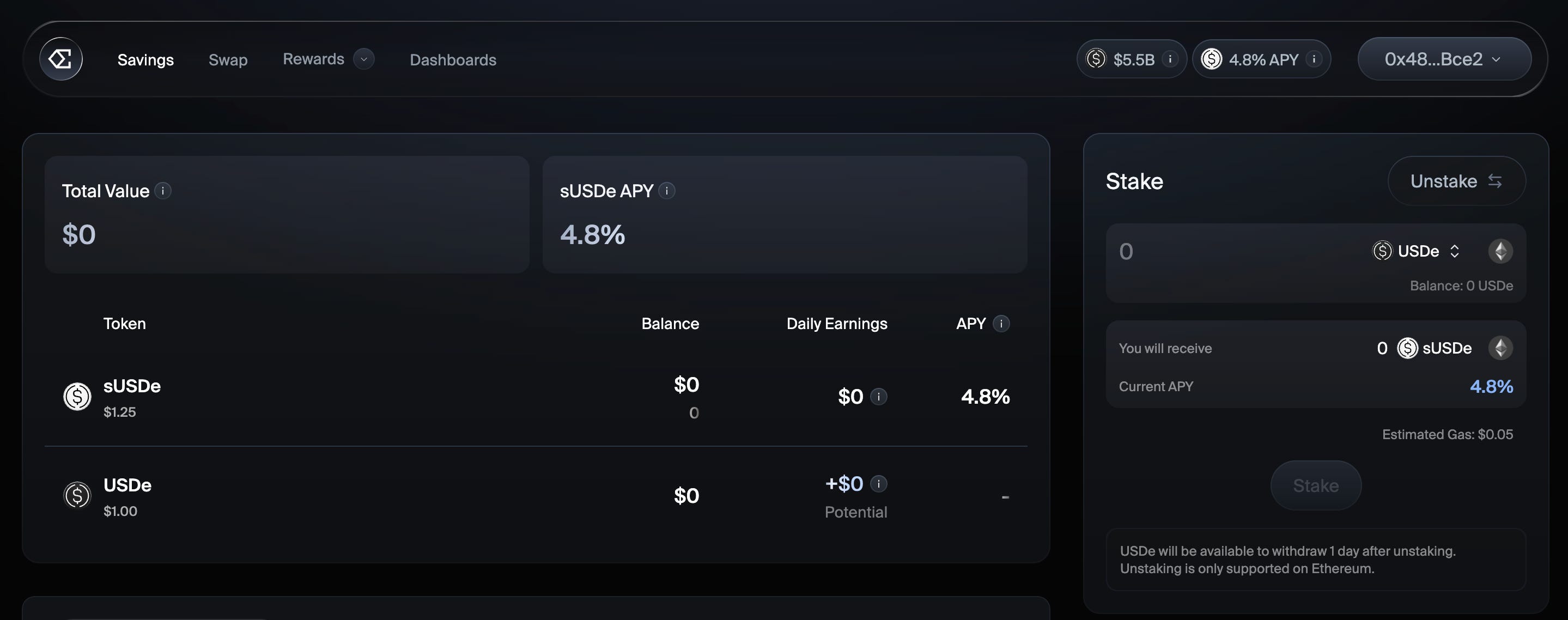
One of the big differences is that unlike USDC or USDT, USDe can actually pay you yield. If you stake it you receive sUSDe which currently earns around 4.8% per year.
Recently Standard Chartered, a major British bank, started publishing research on Ethena. Big banks employ analysts who write regular reports and price forecasts on the companies and assets their clients might invest in, so for Standard Chartered to start doing that for a DeFi project is a pretty big deal for the project!
The bank forecasts that USDe supply could grow around eight times, from about $5bn today to $40bn by the end of 2028. This is aligned with the clear theme that we’re seeing around the growth of stablecoins as TradFi and crypto move closer together.
How It Works
Let’s say someone deposits $100 of ETH to create $100 of USDe. Ethena immediately opens an equally sized bet that ETH will fall, using perpetual futures, or perps, on crypto exchanges - note that I’ve previously discussed perps in this post below if you want to learn more.

If ETH halves, the ETH is now worth $50, but the bet against it has made $50, so the backing is still worth $100. If ETH doubles, the reverse happens and the total still holds at $100. Whatever ETH does, the two sides cancel out and the dollar value stays put!
The yield then comes from two places:
Staking rewards earned on the ETH that sits in the backing.
Funding rates. In perpetual futures markets, when most traders are betting on prices going up, they pay a small regular fee to the traders on the other side. Ethena is on the other side, so in bullish markets it collects those payments.
So the yield is real income generated by a trade, and USDe is backed by real onchain collateral that you can actually see on their website.
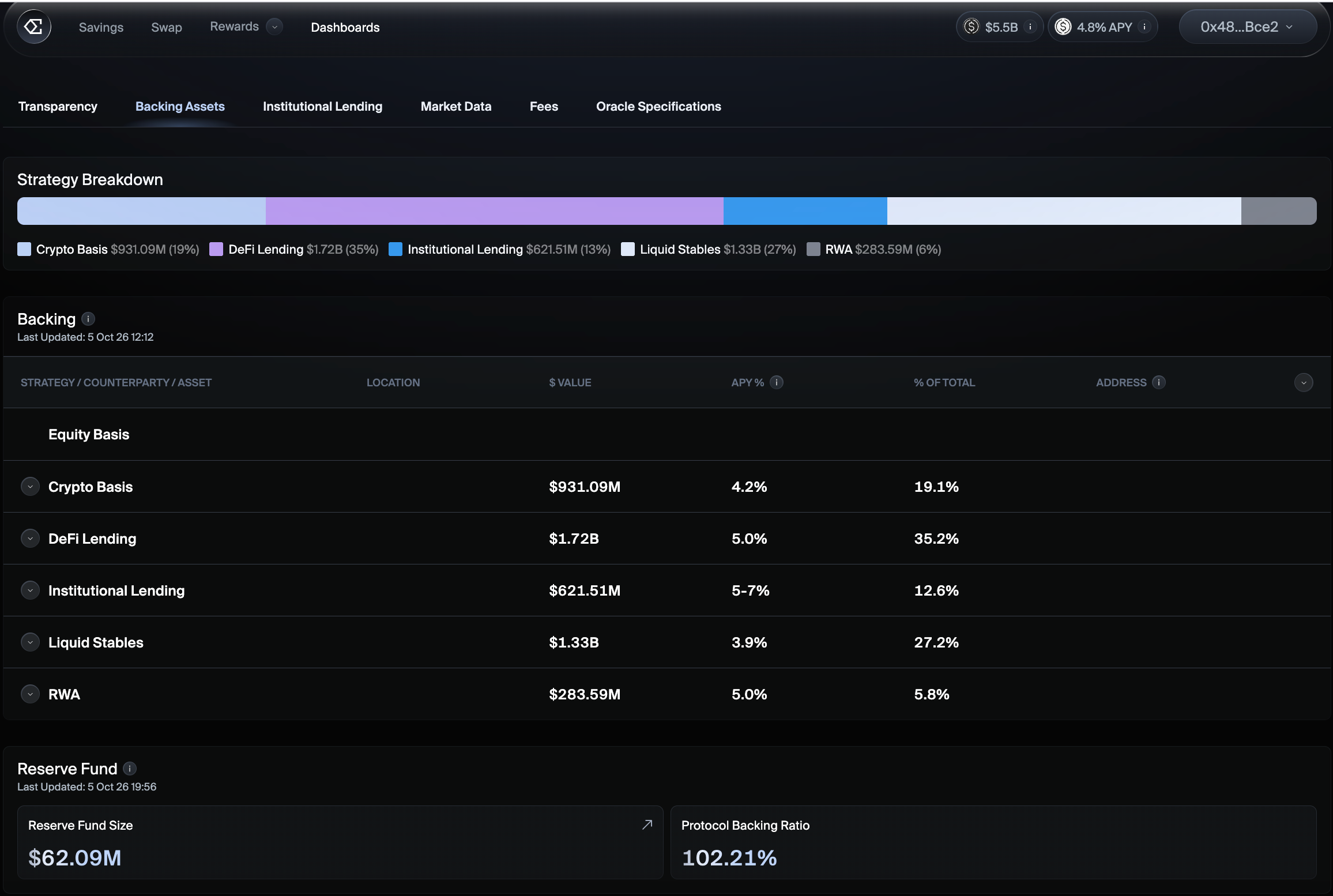
Holding USDe gives you the dollar on its own, while staking it as their staking token sUSDe gives you the dollar plus a share of that income from the two sources mentioned above. Around 60% of all USDe is now staked and therefore earning yield.
The yield moves with the market though. Funding rates paid around 11% a year on average in 2024 and around 5% now, which is why sUSDe’s yield has come down from the double digits it offered in its first year. However 5% is still a solid yield even in today’s market.
Staking USDe to get sUSDe is incredibly simple. Just open up their interface on the app.ethena.fi website, click on the “Savings” tab and you’re given a clear option to Stake or Unstake, and hence move between USDe and sUSDe.
ENA
ENA is Ethena’s governance token. There are 15 billion ENA in total, and it currently trades at around $0.25.
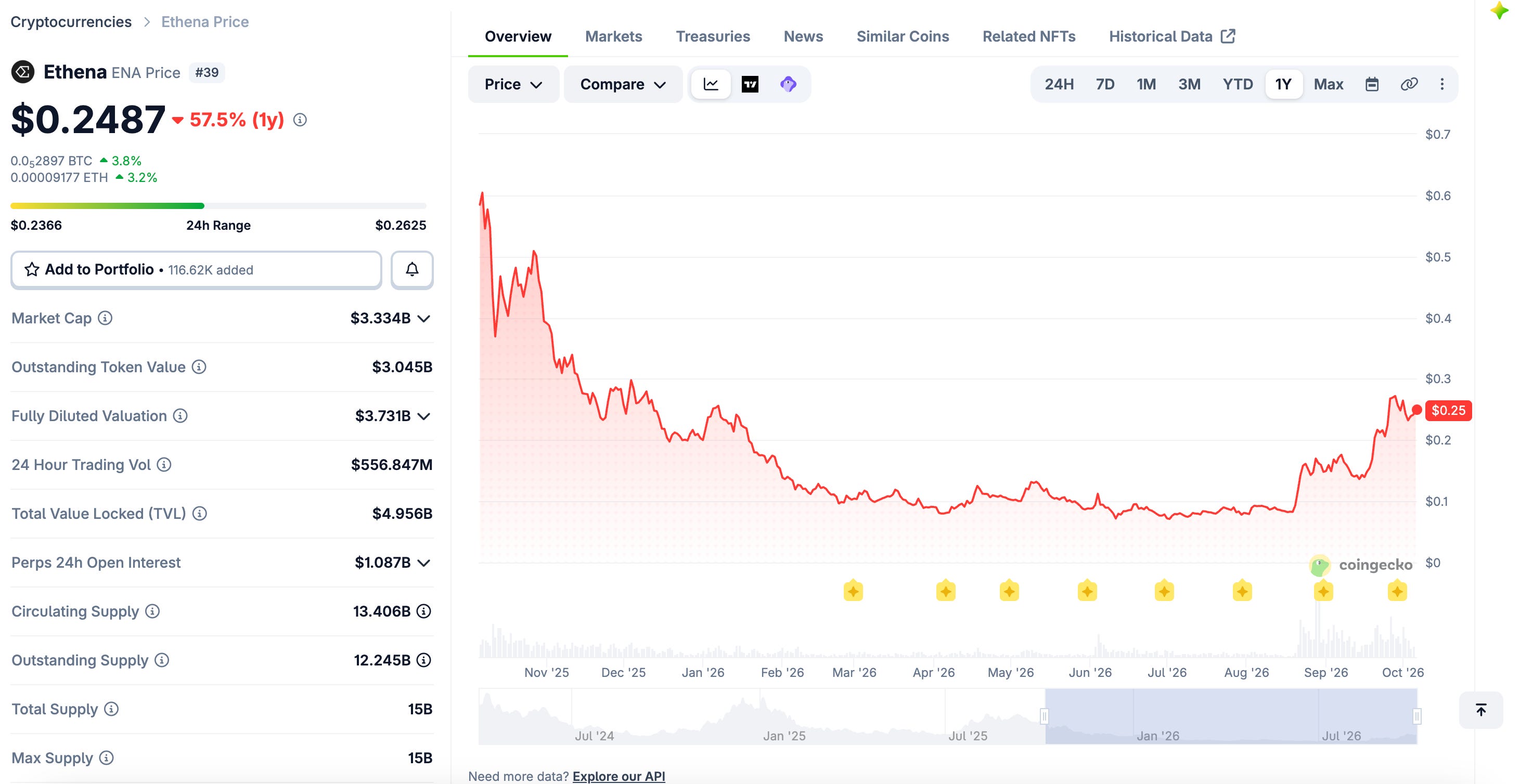
For a while ENA had the same problem as a lot of tokens. Early investors were selling, and new tokens unlocking every month added to that selling. Holders also couldn’t see how the protocol’s revenue was ever going to reach them.
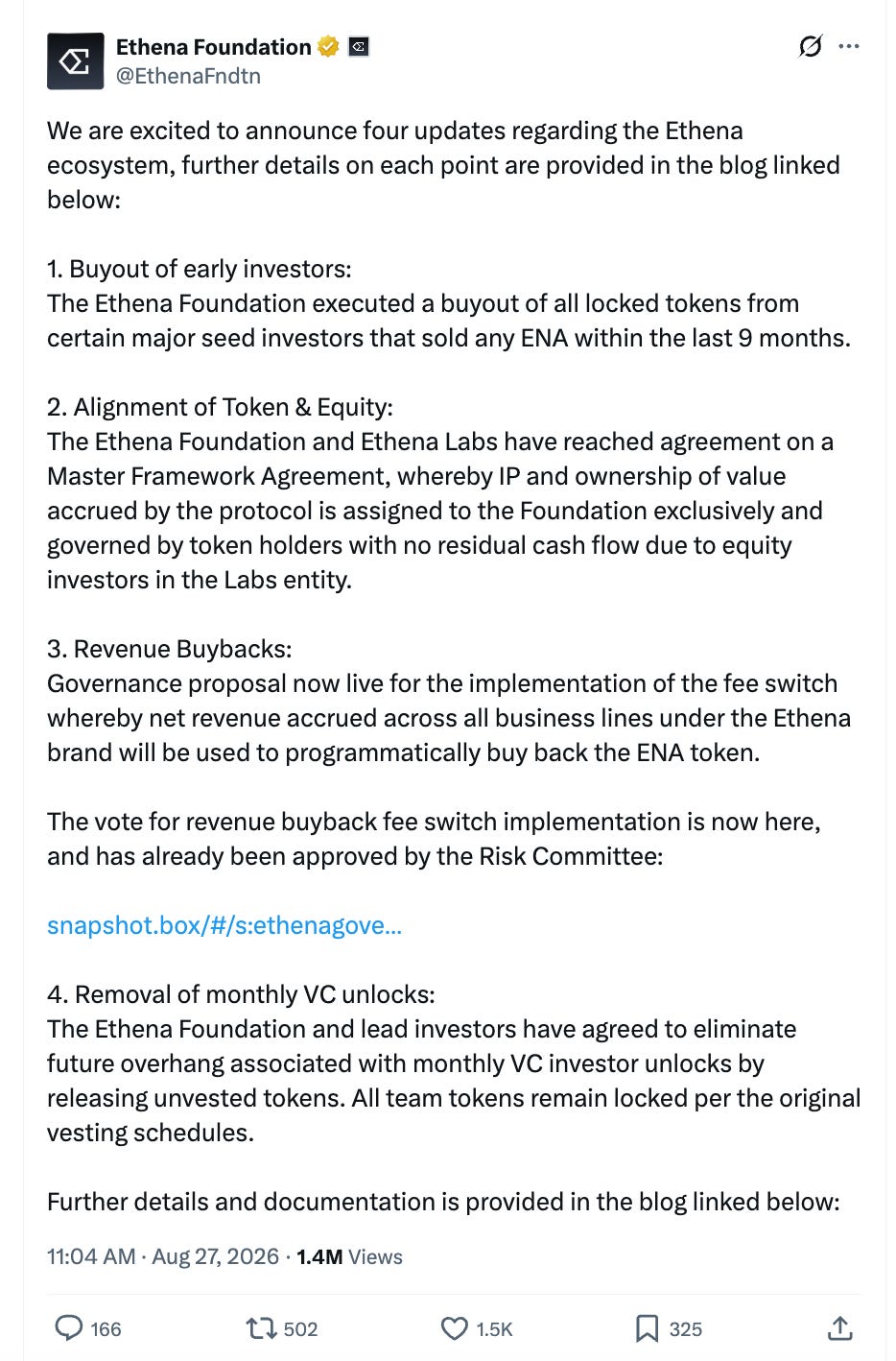
However, a couple of months ago in August the Ethena Foundation announced an overhaul to fix this:
The foundation bought all the locked tokens belonging to major seed investors who had sold ENA since the October 2025 peak.
Ownership of the protocol, and the value it generates, moves to the ENA-governed foundation rather than the shareholders of Ethena Labs.
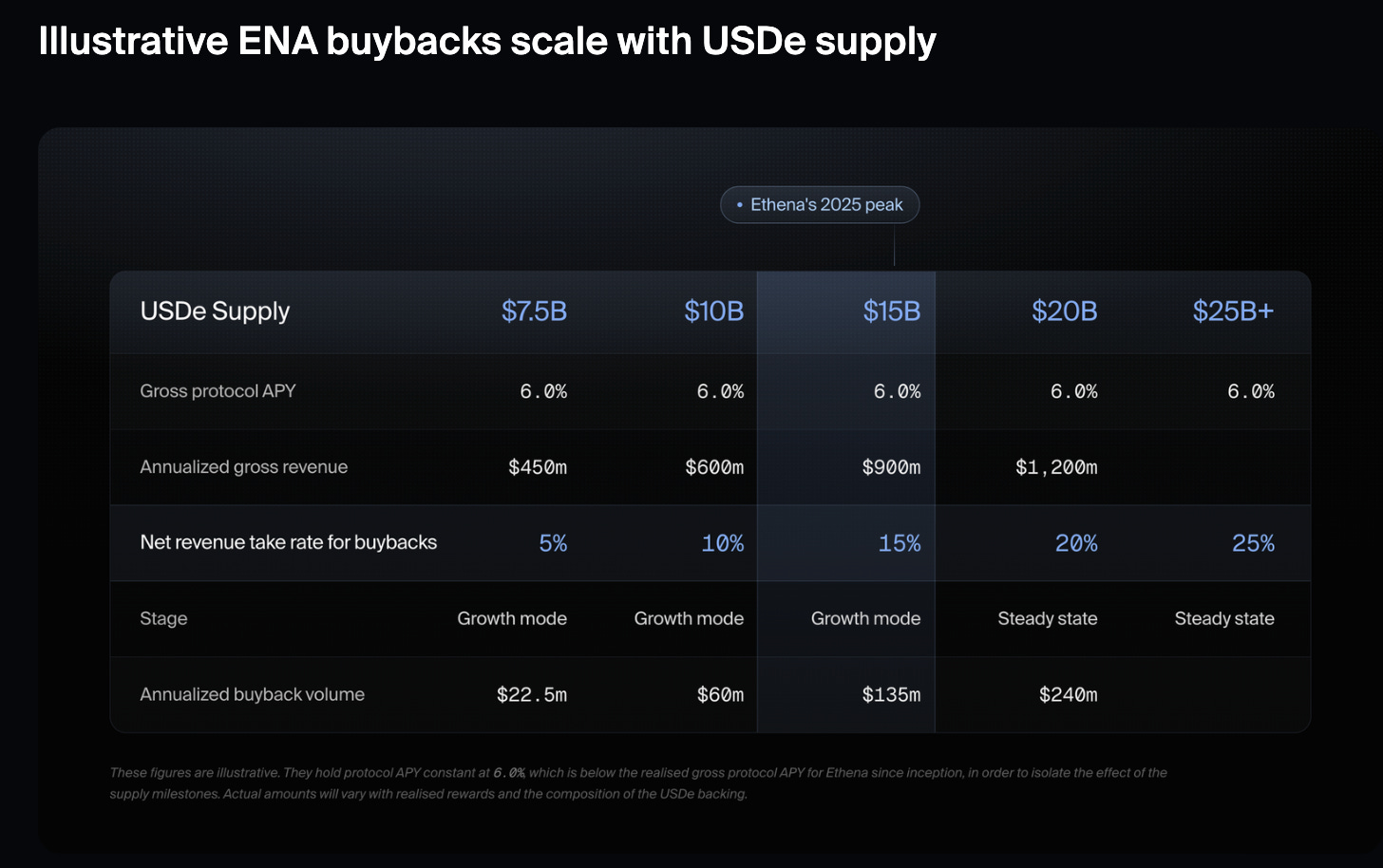
A "fee switch", which turns on once USDe supply passes $7.5bn. From then on, part of Ethena's revenue goes to buying back ENA, starting at 5% and rising in steps to 25% once supply passes $25bn.
Monthly investor unlocks are ending. Instead, all remaining investor tokens were released in one go on October 5th, after which only around 12% of supply stays locked, made up of team, ecosystem and foundation tokens.
As a side note, I’ve discussed token buy backs before if you are not fully aware how they work and the incentives they generate in this post here.

Ethena’s own illustration, assuming a 6% yield, puts buybacks at around $22.5m a year at $7.5bn of supply, rising to $135m a year at $15bn, which is roughly where USDe peaked last year. Ethena says the schedule is designed to support growth back to that peak, and it’s aiming for more than $100bn of USDe within five years!
While the USDe stablecoin is Ethena's primary business initiative, it also lets other companies launch their own stablecoins using its infrastructure. And just this week EtherFi, a crypto platform with over $300m in stablecoin deposits and more than 100,000 active crypto cards, announced its own stablecoin powered by Ethena!
EtherFi joins Jupiter, MegaETH and Sui, which have already done the same, and the revenue from these additional stablecoins is included in the buybacks once the fee switch turns on.
All of this is why Standard Chartered’s ENA price targets lean so heavily on USDe growing again. The bank expects $0.42 for ENA by the end of this year, $1.10 in 2027 and $2 by the end of 2028.
The catch is that the buybacks haven’t started yet. USDe supply is around $5bn, so it needs to grow by about half before the fee switch turns on. Ethena also stopped paying ENA incentives to USDe holders on September 30th, so from here any growth in the supply has to come from the yield itself rather than token rewards.
Risks & Crash
The biggest risk for Ethena is built into the USDe yield, which relies on traders mostly betting that prices will rise, and in a long bear market funding rates can turn negative. When that happens Ethena pays rather than collects, and it keeps a reserve fund for exactly those periods.

Ethena also depends on centralised exchanges, since that’s where its hedges sit. If a major exchange collapsed or froze withdrawals, part of Ethena’s hedge could be stuck with it.
Moreover, when yields fall, money tends to leave, supply shrinks, and the ENA token narrative gets weaker along with it.
The moment that did the most damage to USDe’s reputation was during the crash on October 10th last year, which I wrote about in the post below.

USDe dropped to $0.65 on Binance while trading close to $1 everywhere else. The problem sat entirely inside Binance. It priced USDe using its own thin order book rather than the much deeper markets elsewhere, and because Binance users could post USDe as collateral, that artificially low price triggered a wave of liquidations.
Two other tokens, BNSOL and Binance’s own WBETH, broke from their prices on Binance in exactly the same way.
Binance brought forward a fix to its pricing system and paid out $283m to compensate the users affected. Ethena continued to work as expected, remained over-collateralised the whole time, and kept paying out $1 for every USDe redeemed.
None of that stopped the headlines though.
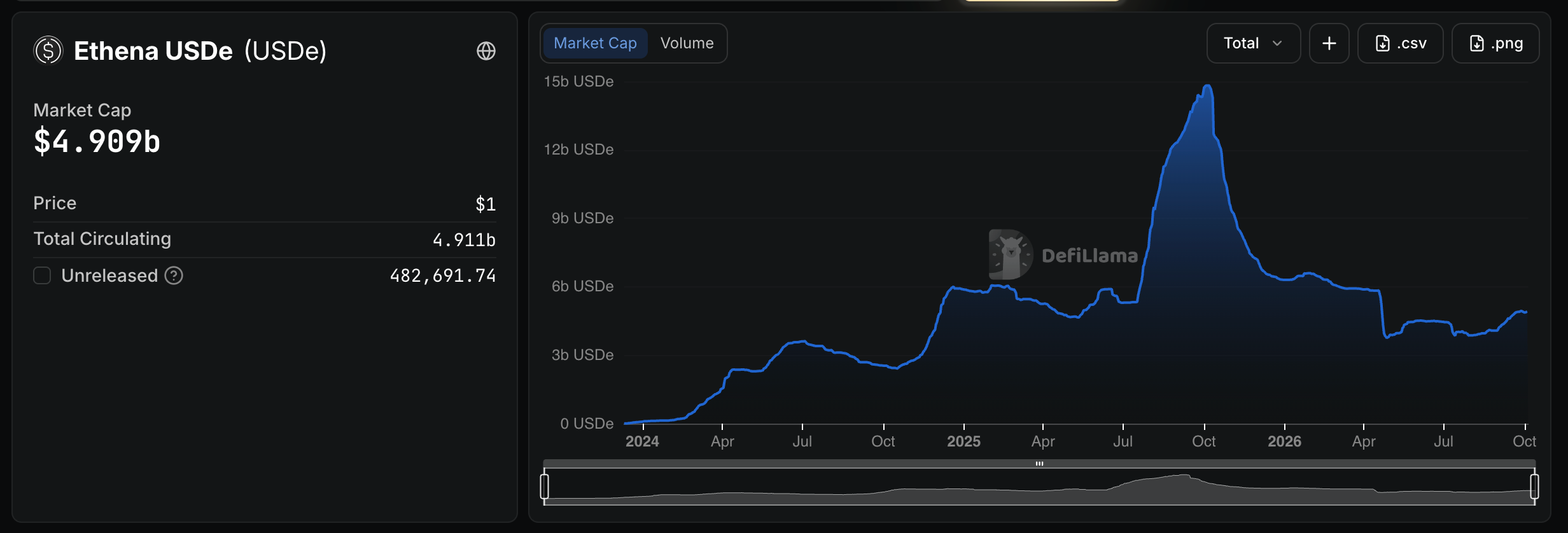
Seeing a synthetic dollar at $0.65 was enough to shake confidence, and around $3bn was redeemed in the aftermath. The market turning lower after the crash added to it, as falling funding rates cut the yield and leveraged sUSDe positions across DeFi unwound. USDe supply has since fallen from its peak of $14.8bn to about $5bn today.
Yet Ethena did what it was designed to do in its toughest test so far, paying out billions at a dollar each over a problem that wasn’t even its own.
Yield-bearing Stablecoin
The GENIUS Act, the US stablecoin law passed last year, bans regulated stablecoin issuers from paying interest to holders. It pushed Circle and Coinbase to restructure how rewards on USDC work.
Stablecoin yield was also the exact fight the banks picked during the recent CLARITY negotiations, as they didn’t want crypto firms competing for people’s deposits, and it was part of what made CLARITY fail as I explained a few weeks ago.

USDe isn’t a GENIUS stablecoin though, because it’s a synthetic dollar as we described earlier, so it can carry on paying yield legally!
That’s a real advantage while the rules stay as they are, and also a genuine risk if lawmakers ever decide to close that gap.
My read is that Ethena has already survived a stress test that its critics expected to break it, and a dollar that pays a market yield is something regulated stablecoins legally can’t offer.
Dollars that earn something by default are a hot debate for TradFi banks, but they feel like an important component of where onchain money is heading, and Ethena is one of the clearest examples offering that today.
And now they’ve improved their tokenomics, and a major bank is betting on them growing again, so I wouldn’t bet against them!

Whenever you’re ready, these are the main ways I can help you:
Want high crypto returns? Earn up to 14% APY with your own Yieldseeker agent!
Love Web3 & AI? Follow @afoxinweb3 on X for insights!
Entrepreneur using AI? Join our AI community to accelerate your results!