
TLDR:
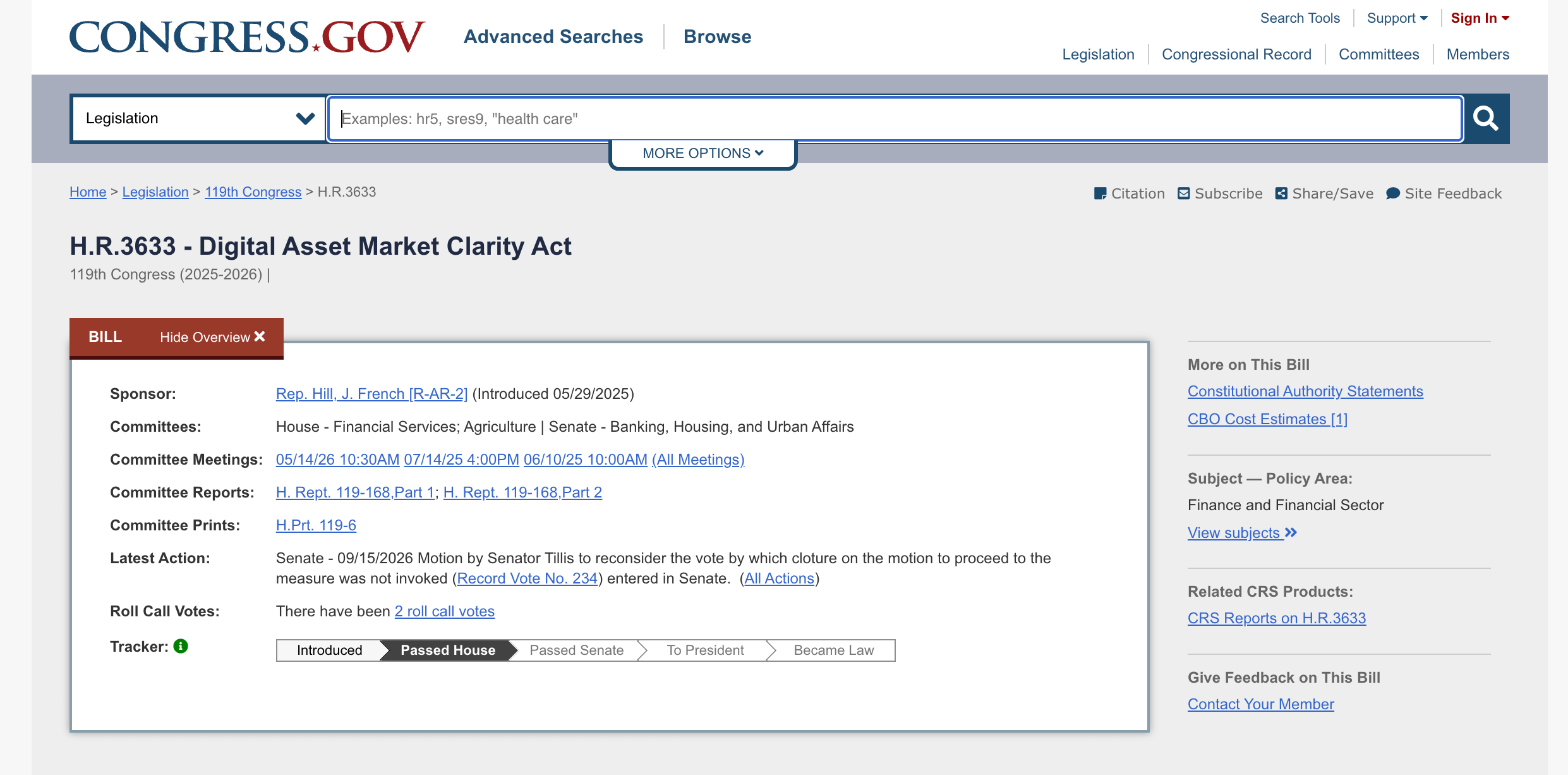
The CLARITY Act failed in the Senate on September 15th by 49 votes to 50, 425 days after it cleared the House with bipartisan support.
It would have replaced years of enforcement risk with a clear rulebook, letting mainstream businesses and institutions finally build on crypto properly.
Two days later the SEC and CFTC both acted anyway, essentially filling the holes that CLARITY was meant to fill, giving the market what it wanted.
Agency rules can be undone, but stablecoin regulation failed for years before GENIUS landed, so CLARITY is far from dead.
Last week the CLARITY act failed to pass the Senate in the US. It’s a key piece of legislation for the crypto industry that’s been on a never-ending back-and-forth since it was passed by the House last year, and that the crypto space has been wanting for many years now.
The failure for CLARITY to pass in of itself was viewed negatively in the space, however immediately after the key regulatory bodies in the US stepped in and began putting in their own rules effectively giving the “go ahead” to the industry, and the market has responded to this bullishly. Today we’ll discuss all of this!
If this post resonates with you and you enjoy the content then please share it with a friend and get rewarded for doing so!

This blog goes out weekly to over 20,000 subscribers. Please message me if you’re interested in sponsorships or partnerships.
CLARITY
The USA has two financial regulators where most countries have one. The SEC (Securities and Exchange Commission) looks after securities while the CFTC (Commodity Futures Trading Commission) looks after commodities and derivatives.
This split was designed decades before Satoshi invented the blockchain. However, this split has been a problem for crypto since day one since nobody can say for sure what agency is in charge of what asset.
That uncertainty came with a real cost. Instead of a rulebook, the industry got years of “regulation by enforcement” with court battles and expensive settlements, with players like Coinbase and Kraken fighting case by case over what they were even allowed to offer.
Most of it happened under the former SEC chair Gary Gensler, a name that still makes many crypto people wince when they hear it.

The lack of regulatory clarity and the constant fear of enforcement meant that mainstream players mostly stayed away from crypto. After all banks, brokerages, payment companies and listed businesses aren’t going to launch a crypto product when nobody can tell them whether they’ll be sued for offering it or not.
That’s why the industry rallied behind some initial form of regulation, which came in the form of the GENIUS Act (Guiding and Establishing National Innovation for U.S. Stablecoins) and the CLARITY Act (Digital Asset Market CLARITY).
And both bills successfully passed through the US House in July 2025, with GENIUS being signed into law the next day creating clear guidelines around Stablecoins and their issuers, such as a rule that issuers need to hold 100% reserves in dollars or US Treasuries - I even wrote about this last year in a post I called “Stablecoin Summer”.

On the other side we had CLARITY that was the other piece of the puzzle and it aimed to create a rulebook clear enough that a compliance department could sign off on it so that crypto could finally start behaving like a normal part of finance.
CLARITY was designed to:
Define the different categories of digital assets and make explicit which regulator was responsible for each one.
Give the CFTC’s full supervisory authority over crypto spot markets - ie. where you buy and sell the asset itself rather than a derivative of it.
Offer limited legal protection to DeFi developers, so they couldn’t be prosecuted for what other people chose to do with their code.
Encode a set of measures aimed at illicit finance.
There was however a lot more in the finer detail of CLARITY, and admittedly plenty of people backing the bill didn’t actually love it. Yet, the feeling across much of the industry was that some regulation beats none, and that an imperfect rulebook you can plan around is better than another five years of guessing or the fear of being sued.
Why It Failed
Last week on September 15th the Senate held a cloture vote on CLARITY, the procedural step that decides whether a bill can move forward at all. CLARITY needed 60 votes, it got 49 “yea” and 50 “nay”, so it didn’t even reach a simple majority.
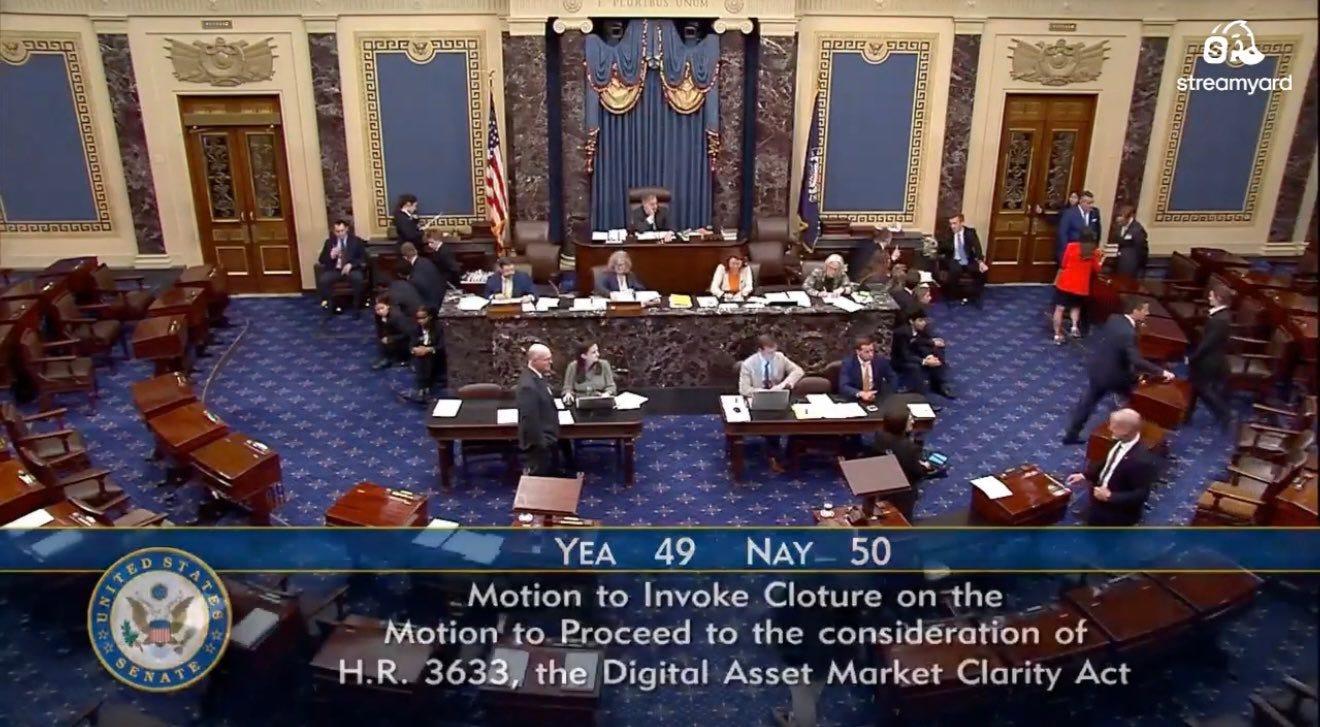
What collapsed was more than 600 pages of negotiated compromise between the two parties, over 425 days since it had passed the House, built on years of industry campaigning and hundreds of millions of dollars of lobbying, political donations and advocacy.
And the thing that killed it had almost nothing to do with crypto market structure. The sticking point was a set of ethics provisions designed to stop senior government officials holding crypto business interests.
Democrats wanted them tighter, specifically around President Trump and his family’s crypto ventures considering he’s generated billions of dollars in net-worth from his TRUMP memecoin and involvement in World Liberty Financial.

Republicans put out a revised version on the Sunday before the vote with new restrictions added, but it didn’t go far enough, and with the November midterms approaching neither side had much incentive to keep budging.
Banks were fighting on a second front. They lobbied hard against a provision that would have let stablecoin issuers pay interest to customers, arguing it would let crypto firms compete for people’s deposits without facing bank-level regulation.
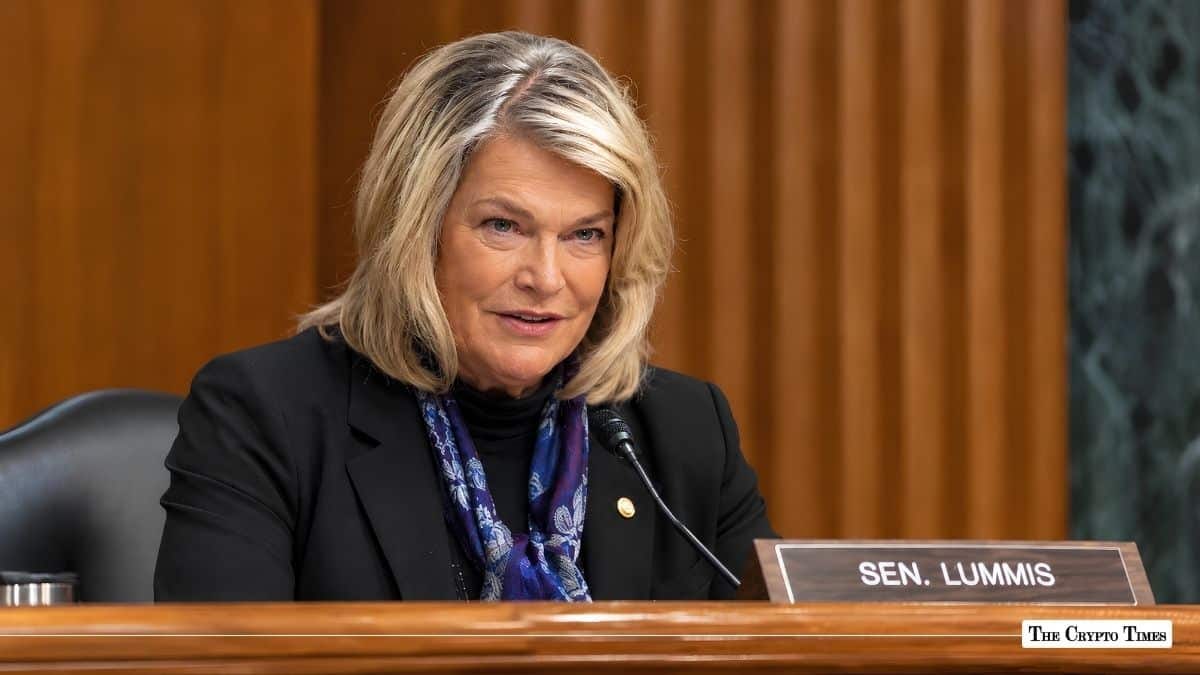
Senator Cynthia Lummis led the negotiation and made the final pitch on the Senate floor. “Do not let this day be the day we handed our future to someone else because we were too afraid to finish what we started,” she said. But It wasn’t enough.
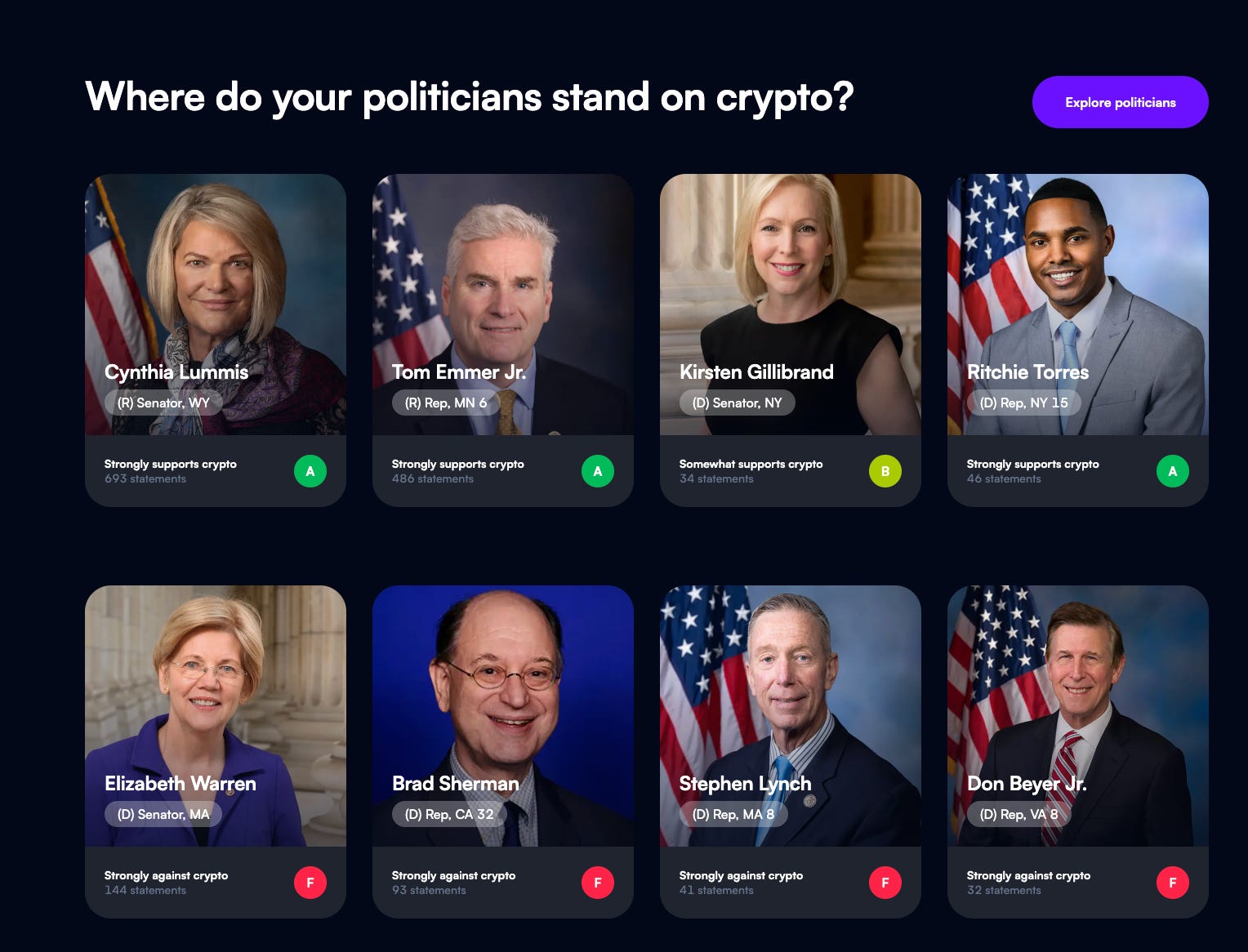
Stand With Crypto, the Coinbase-backed advocacy group, had announced beforehand that it would “score” the vote, meaning senators’ choices go onto its public scorecards ahead of November 3rd, and the votes are now visible on their website.
After over a year of back-and-forth between Democrats and Republicans and the President actively signing off multiple times on ethics revisions, CLARITY failing to even pass cloture felt like a massive loss to the crypto industry who’d rallied so strongly to just get some so-called “clarity” through regulation.
Although it felt like a real loss, it seems like their pleas were heard though by the actual regulatory agencies themselves.
The SEC's Move
CLARITY died on the Tuesday, by Thursday the SEC had rolled out its own “innovation exemption”!
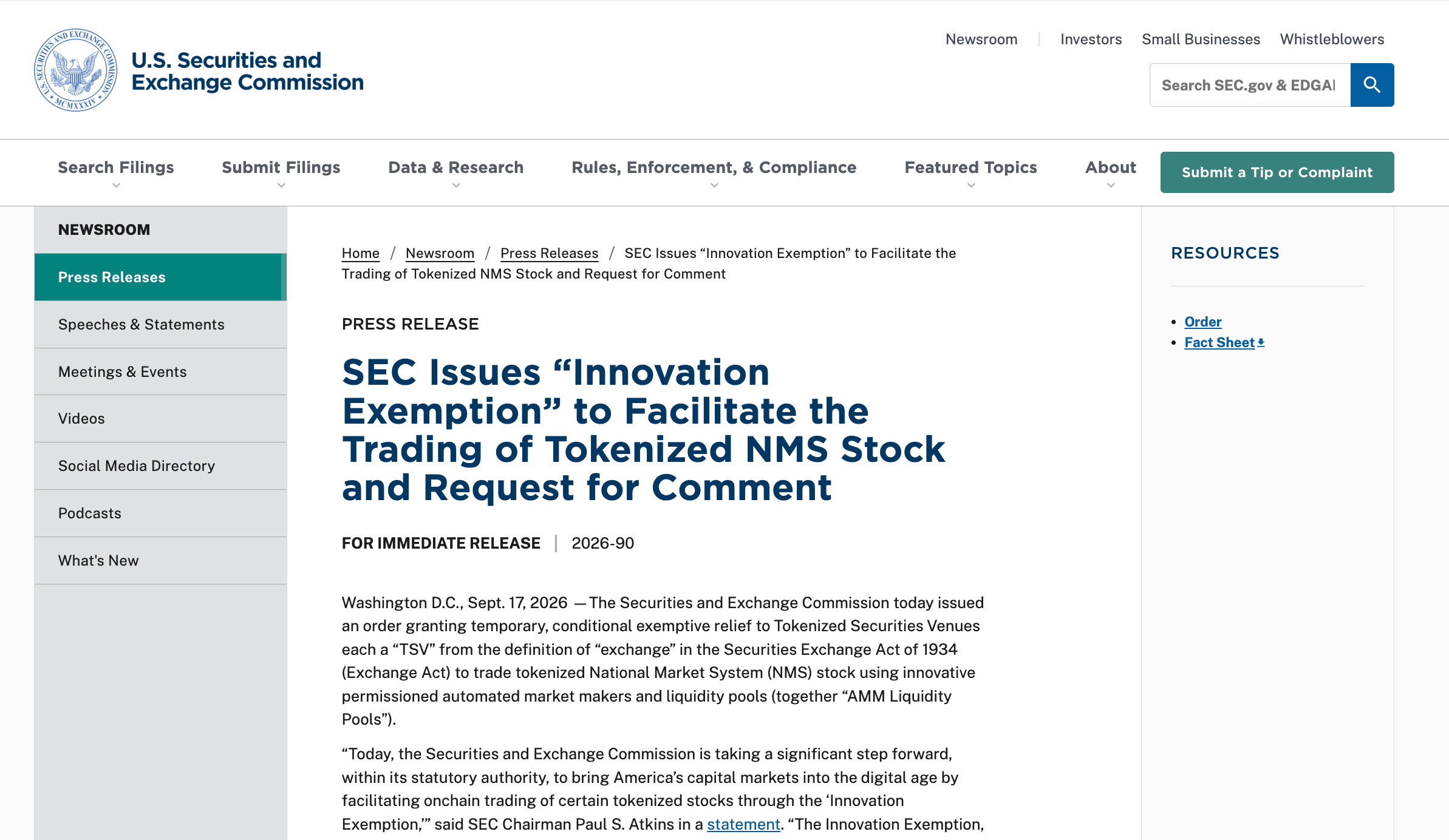
The exemption lets venues trading tokenised securities operate for up to five years without registering as a stock exchange. That covers tokenised versions of shares already listed on US exchanges as well as stocks tokenised by third parties, and it took effect immediately.
In plain terms, this is the regulatory door opening on 24-hour trading of tokenised stocks. This is exactly the mainstream integration CLARITY was supposed to unlock, arriving through the regulator directly. It’s traditional finance moving onto crypto rails with a regulator’s blessing.
This came as part of a much bigger programme rather than just a one-off. SEC chairman Paul Atkins launched an initiative called “Project Crypto” that has several things moving at once.
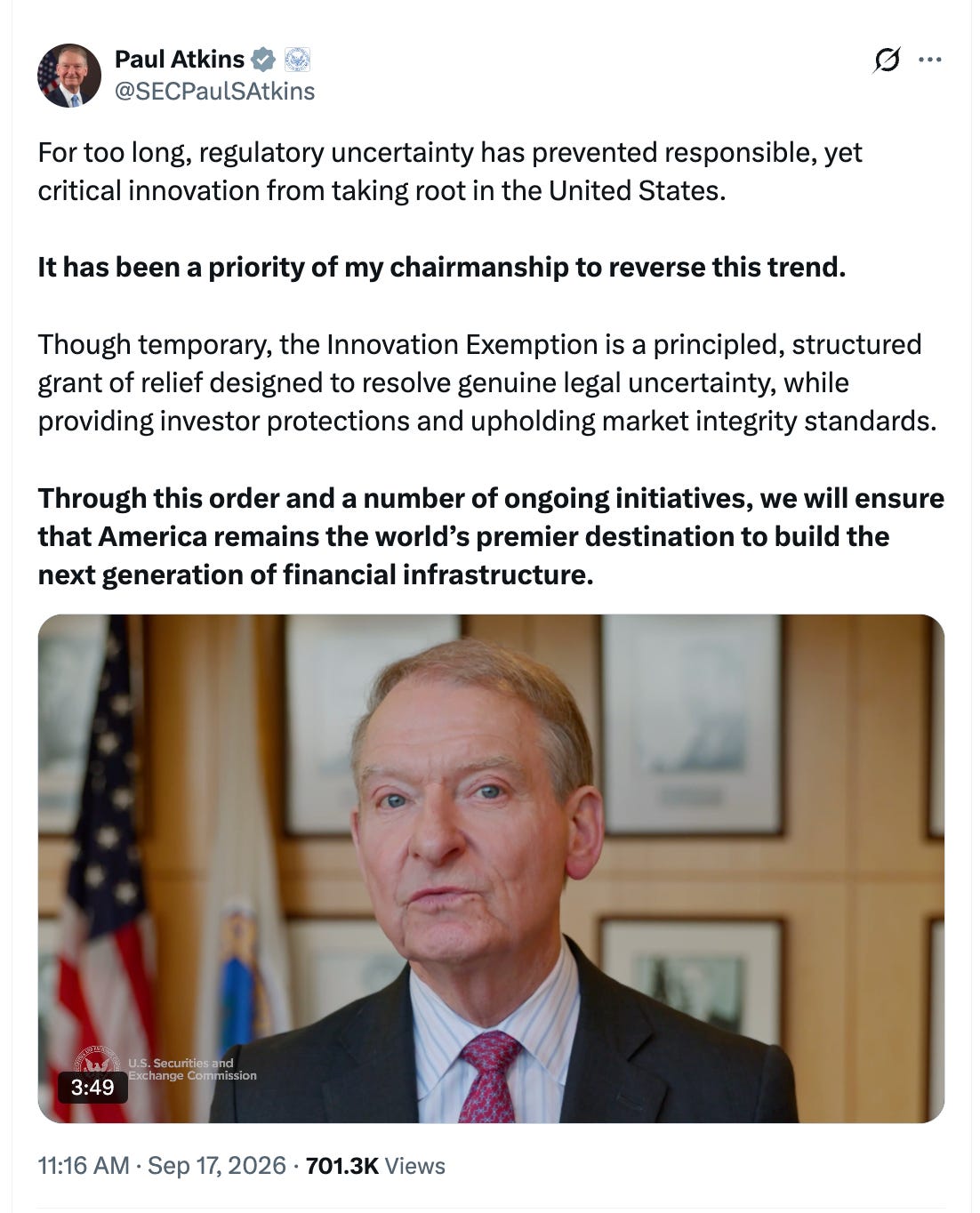
Additional rules proposed in August would let crypto projects raise money without immediately triggering the full weight of securities requirements. A separate proposal from September 10th would let blockchain records officially count as proof of ownership. A custody rule for investment advisers is close behind.
And earlier this year the SEC and CFTC jointly published a “taxonomy,” the first proper definitions of which crypto assets count as securities.
That’s a remarkable amount of activity for a few months! One policy analyst described the agencies as now able to “shift into overdrive with aggressive, pro-industry proposals.”
The CFTC's Move
On the same Thursday after CLARITY failed to pass, the CFTC pushed through their own commitments to the industry with the release of their “Staff Letter 26-25”.
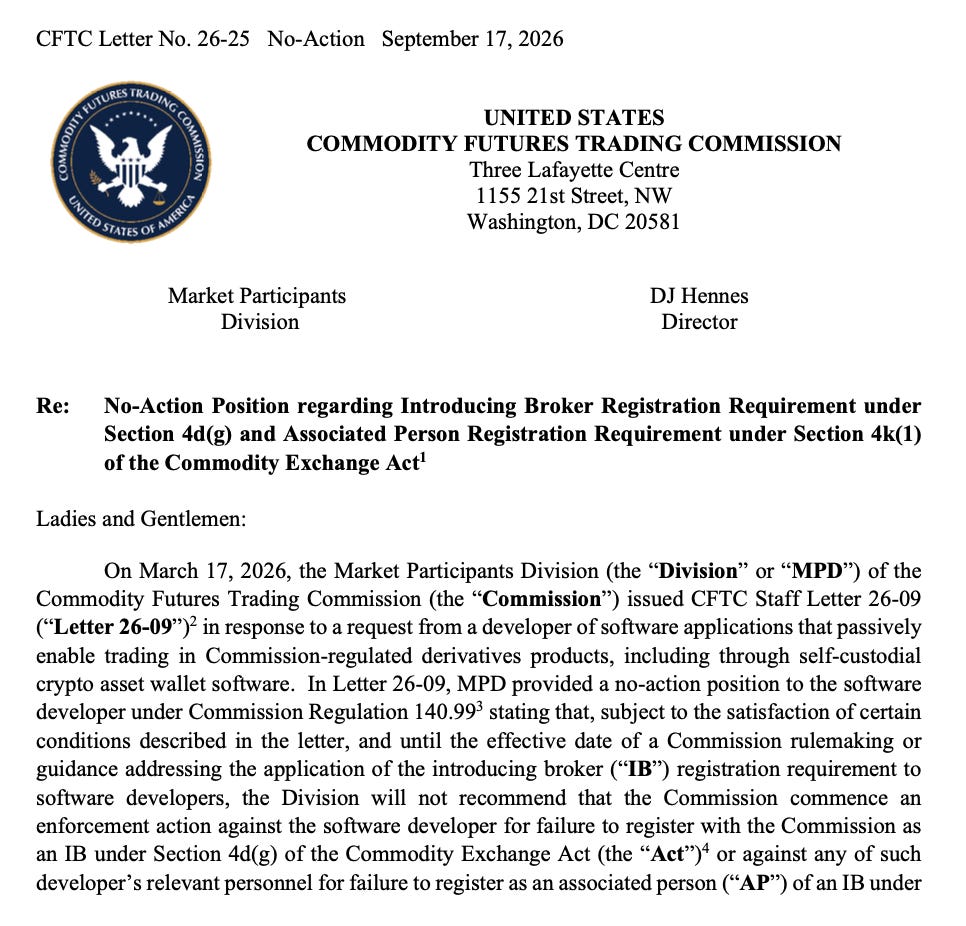
If you build a wallet or a front-end that lets someone trade crypto derivatives, there’s been an open question about whether that makes you an unregistered broker in the eyes of US law. That risk has hung over everyone building interfaces in this space for years.
Staff Letter 26-25 clears it. Any “passive software provider” is now safe from enforcement as an unregistered broker, covering wallets, apps and front-ends that display markets and pass on orders for CFTC-regulated derivatives, including perpetuals and event contracts.
It’s an extension rather than something invented from scratch. A letter back in March granted this to one self-custodial wallet developer, and September’s version opened it up to anyone who qualifies.
CFTC chairman Mike Selig is currently the only sitting member of what is supposed to be a five-person commission, so he’s been able to do all of this on his own!
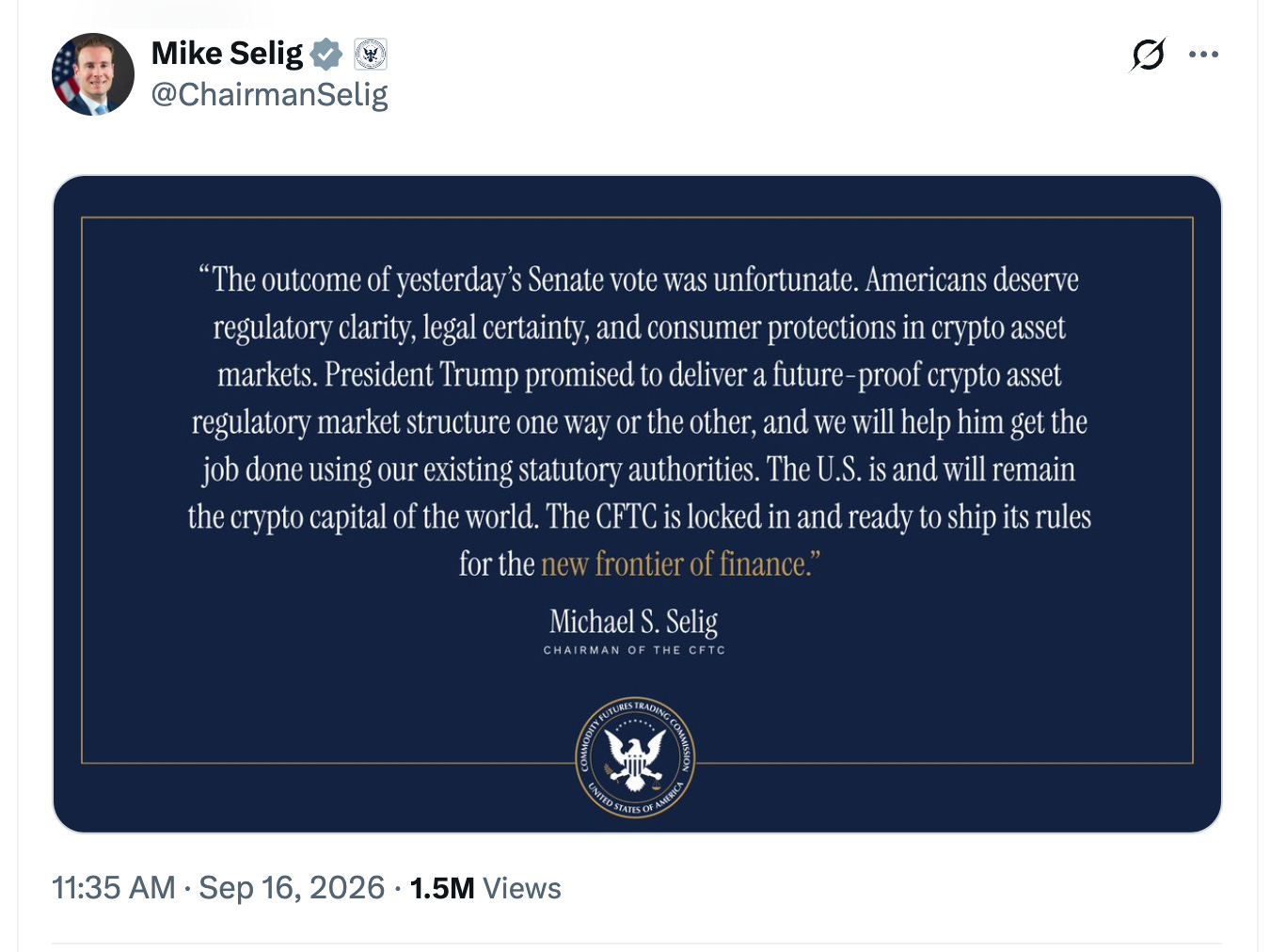
On that same Thursday he also sent something much bigger to the White House. A filing on the government’s own regulatory tracker shows the CFTC submitted a proposal titled “Regulation Crypto Asset Transactions and Regulation Crypto Asset Markets,” which covered both crypto trade execution and market structure.
That’s essentially the CFTC half of CLARITY, arriving by regulation rather than by law!
Importantly, there’s still a bit of back-and-forth here with space for public comments and the White House to review it before it actually takes effect. However it’s formally logged as a “pre-rule,” which is the stage before a proper proposal exists, and the work has started behind the scenes on making it happen!
Rules without a law
So both the SEC and CFTC stepped in and filled the hole that CLARITY was meant to fill in, is this as good as CLARITY? Not quite, and the person saying this the loudest is the SEC chairman himself.
Paul Atkins has repeatedly argued that his own agency’s work needs legislation behind it. In August he said “legislation remains indispensable to enacting ‘future-proofed’ rules of the road that are durable enough to protect the work we are undertaking today from being unwound by a future rogue regulator.”
Guidance can be rewritten by the next chairman, a formal rule can be undone the same way it was made, and rules without a statute underneath them are easier to challenge in court. A law like CLARITY lays down sturdy foundations, everything the agencies are doing right now can be blown away like sand.
There’s a clock on it too. The midterms on November 3rd decide the next Congress, and the House is widely expected to flip from Republicans to Democrats, and if it does then crypto market structure will likely drops off the agenda for a while.
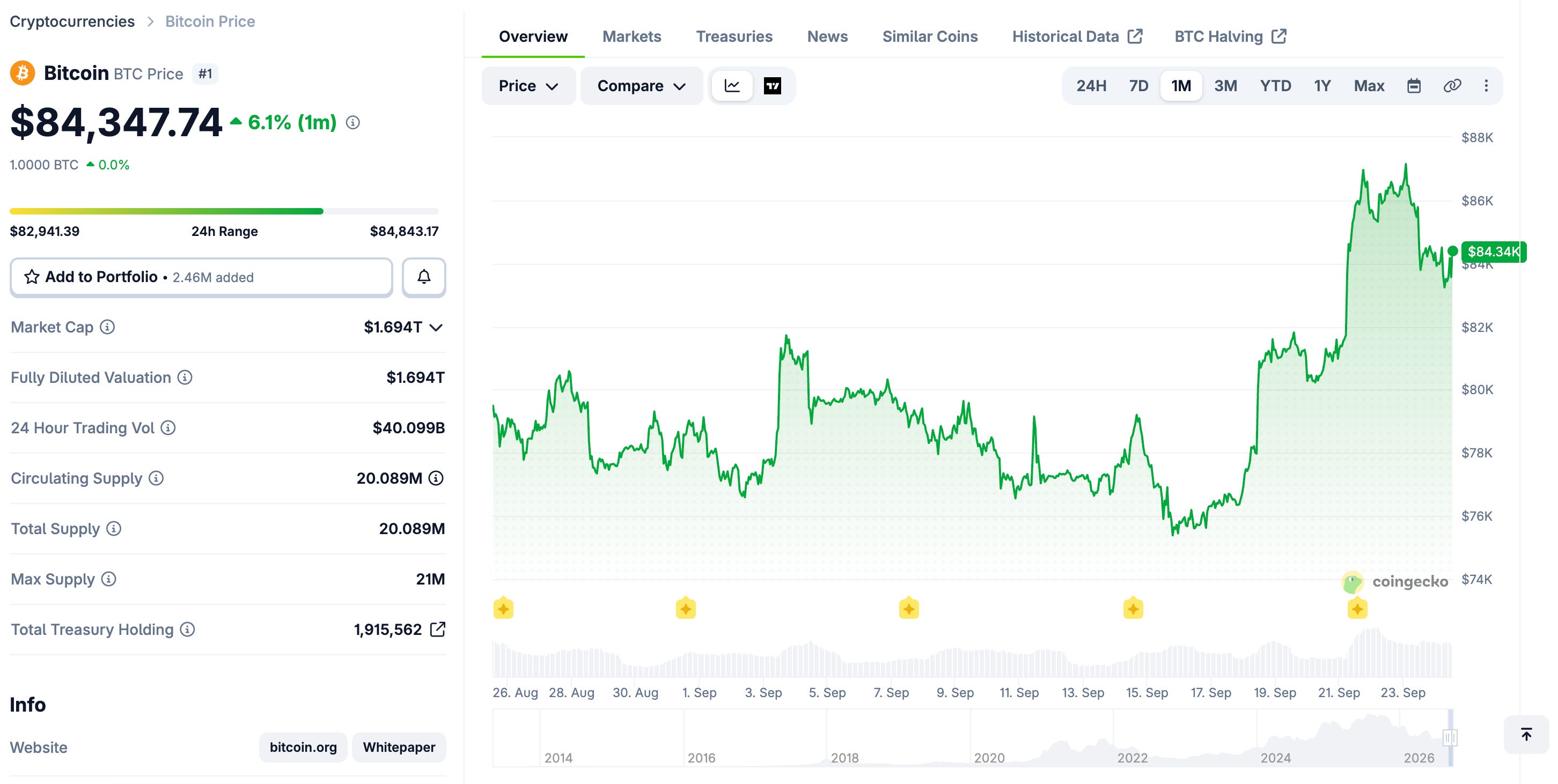
The market seems to be happy though with the work that the SEC and CFTC have began to put in, and shifted bullish. Bitcoin’s back over $80k and on an upward trend, with coins like Zcash, UNI and VVV up over 100% this past month!
An important consideration is that Stablecoin regulation looked exactly this dead, twice before. An original stablecoin bill cleared committee in 2023 and went nowhere, and a second was tried again in spring 2024 and failed too. Then the GENIUS Act was introduced in February 2025 and signed into law in a landslide vote!
These fights get lost before they get won.
My read is that a bill failing 49-50 sounds like a defeat, and it was, but the thing the industry actually wanted is arriving anyway. Slower than a law and on shakier ground, sure, yet the certainty that lets mainstream businesses take crypto seriously is being built piece by piece by the regulators, and the market’s reacting accordingly.
The law will come eventually. In the meantime that groundwork is being laid at exactly the point in the 4-year cycle where groundwork usually gets laid, and that’s a good place for us to be!

Whenever you’re ready, these are the main ways I can help you:
Want high crypto returns? Earn up to 14% APY with your own Yieldseeker agent!
Love Web3 & AI? Follow @afoxinweb3 on X for insights!
Entrepreneur using AI? Join our AI community to accelerate your results!