
TLDR:
I joined AlphaGrowth’s Dose of Alpha Live show for an hour to talk about “agentic finance” ie. that AI agents will manage a big part of our financial lives.
We discussed whether AI agents or professional vault curators should manage your yield, and landed on both, with curators vetting and agents optimising them.
Handing your money to an AI only works if it can’t go rogue, which is why for YieldSeeker the agent’s guardrails are a core aspect of the product.
The long-term vision is personalised finance for everyone, the kind of service that used to need a private banker, democratised for all through AI.
Last week I did an hour long podcast with the team from AlphaGrowth who are curators of several different DeFi lending vaults. We had such a great discussion going from how YieldSeeker began, to my particular vision on where the space is going and the future we’re building towards. So for this week’s post I decided to summarise the call below.
This blog goes out weekly to around 20,000 subscribers. Please message me if you’re interested in sponsorships or partnerships.
And if this post resonates with you and you enjoy the content then please share it with a friend and get rewarded for doing so!
YieldSeeker is your onchain AI financial manager. Use specialised onchain agents to manage DeFi activity such as earning yield, borrowing, and portfolio management, without constantly monitoring positions yourself. Your funds remain non-custodial as agents operate through secure smart-wallet infrastructure within the permissions you set. YieldSeeker agents monitor opportunities and risk around the clock, while you retain control over your funds.
Dose of Alpha Live
Last week I joined Bryan Colligan and Eric Waisanen from AlphaGrowth on their show, Dose of Alpha Live, for an hour-long conversation about AI and DeFi.
You can watch the full episode below, which starts at the 10 minute mark after the pre-show music.
AlphaGrowth is a firm that helps DeFi projects grow their liquidity and also curates its own lending vaults on Euler.
Bryan is its founder and Eric leads its strategy, and I met them at The Bridge by The Tie in New York, where we started to discuss agentic finance which we then continued on their show!
If you’d like to jump straight to a particular part of the conversation, here are the main moments.
The big idea we kept coming back to was “agentic finance”, the idea that within five to ten years a big chunk of your financial life will be run by AI agents that you simply talk to.
The way I see it, two magical technologies are coming together. Generative AI enables machines to do things for you just by asking in natural language, and DeFi lets anyone in the world use financial services without needing a bank’s permission.
That’s what led my cofounder Krishan and I to build YieldSeeker!
At the tail end of 2024 a wave of AI agents launched in crypto, but most of them felt like memecoins with an AI label stuck on them. So we asked a simpler question, what agent actually makes sense to build?
Our answer was one that manages your yield, which started as a hackathon project at ETHGlobal and became something larger mid last year, and has since grown into us building an ecosystem of specialised onchain agents.

Agents and Curators
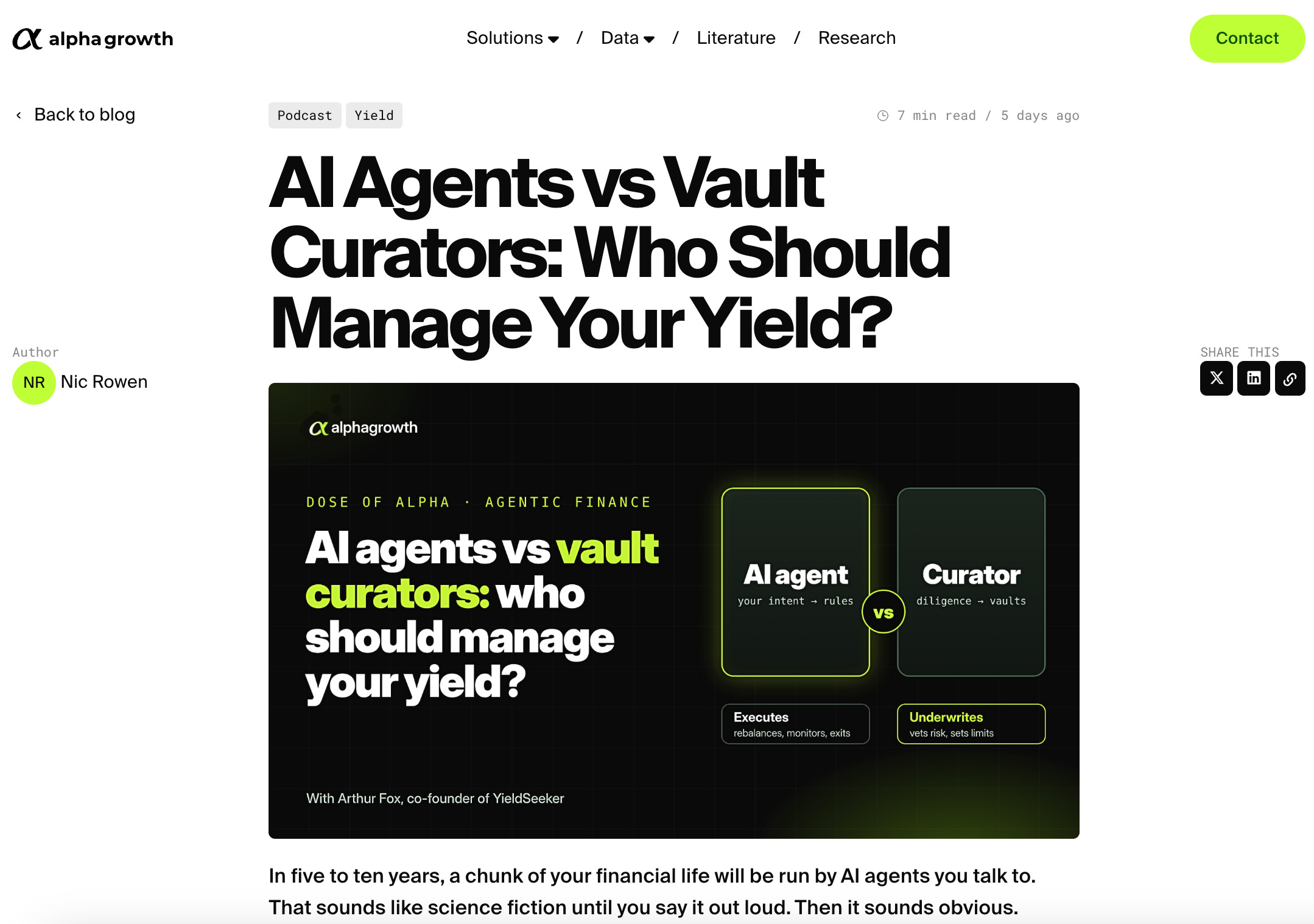
AlphaGrowth titled the episode “AI Agents vs Vault Curators: Who Should Manage Your Yield?”
“Vault curators” are the professional risk managers of DeFi. Firms like Steakhouse, Gauntlet and AlphaGrowth themselves build lending vaults on protocols like Morpho, and decide which borrowers your deposits get lent to and on what terms, a bit like a fund manager for lending. I covered how this works in my Morpho post.

In our discussion the answer we landed on for the question above was both, each doing a different job. Eric described it as “B2AI”, where AI agents serve everyday users and curators serve the agents. In this vision of the world agents are the new interface and curators are the new underwriters.
I agreed with Bryan’s point that AI already creates far more research than anyone can read or check, and even though general AI models know more than him about almost everything, they still fall short in the niche where he’s an expert. That last 1% of expert judgement is where the real edge is.
That’s exactly why we don’t let YieldSeeker’s agents loose on any vault they can find. Agents can only use a whitelist of 40+ vetted vaults across 8+ protocols like Morpho, Euler, Compound and Aave, and the conservative setting sticks to vaults run by well-known curators like Steakhouse, Gauntlet and Spark.
Within those limits, you tell the agent your intent rather than giving it instructions. Early versions of YieldSeeker let you say “move my money from here to there”, but most people don’t want to manage every move.
Instead you set rules in plain English, like “only use vaults with over $10M in deposits”, and the agent turns them into rules it has to stick to, whilst it optimises your yield for you on autopilot.
Security
Before any of that matters though, the money has to be safe. As I said on the show, I wouldn’t be able to go to sleep at night if users’ money could simply disappear!
Last month’s Binance hack, where North Korean hackers spent months working their way into the world’s largest exchange, is a very visual example of how high the stakes are here.

So at YieldSeeker the guardrails are the product, and we’ve built them in layers:
Each agent’s wallet runs on Coinbase’s developer platform, so the hardest part of keeping private keys safe sits with Coinbase.
On top of that, our own smart contracts, audited by Nethermind, only let funds move between approved vaults, so not even our own team could take users’ money.
The smart contracts also ensure that money can only been withdrawn from an agent’s wallet when the user signs the withdrawal call themselves.
Adding any new vault goes through a multisig and a four-day “timelock”, visible onchain, so if anything were ever compromised there’d be four days to react.
Monitoring watches every vault around the clock and pulls funds out automatically if things like its available liquidity drop below a safe level.
Eric put it to the test by asking about a day like 10 October 2025, when the market crashed and $19bn of positions were liquidated in 24 hours.

An agent told to “go find the highest yield” could have walked straight into trouble. The answer is the combination of vetted vaults, liquidity limits and the ability to pull out the moment something breaks.
Mars and Satellites
To explain where we’re heading, I borrowed a metaphor from SpaceX. Colonising Mars is the grand vision in the long-run, but putting satellites in low orbit is what pays the bills today.
For us, Mars is fully personalised agentic finance. You’d tell an agent, or a whole team of them, to “manage my finances”, and three people with different appetites for risk would each end up with a different portfolio. Someone in Southeast Asia or Africa could ask for a mix of dollars, Bitcoin and S&P 500 exposure, and it would just happen!
Bryan compared it to how much of America’s wealth is managed by registered investment advisers (RIAs), the professionals who manage money on clients’ behalf. Agentic finance is an onchain, AI version of that, tailored to each person.
The satellites are what we’re shipping today, namely agents for yield, borrowing and soon portfolio rebalancing, along with putting our agents inside other apps so they handle distribution for us. I covered our latest agents a couple of weeks ago.

One of the core ideas underpinning this AI revolution is personalisation. The Industrial Revolution was about mass production, where everyone got the same coat, the same car and the same dose of ibuprofen. AI moves the other way.
Personal service used to mean a tailor or a private banker, and AI can make that kind of service democratised for everyone.
That changes our role too. In a car factory, robots build the car and a person checks the parts ended up in the right place. With financial agents, your job becomes checking that your Bitcoin ended up where it should.
Developers working with AI have already made that shift. As I said on the show, they’ve all become CTOs who review the result instead of writing every line of code.
F, Marry, Kill
The AlphaGrowth guys like to end their show with a narrative game where every guest picks which of three crypto trends to F, marry and kill. Mine were:
Agentic finance.
The “DeFi mullet”, fintech in the front and DeFi in the back, like Coinbase’s lending product quietly running on Morpho.
Real-world assets (RWAs), like tokenised stocks and treasuries.
I found it tough to kill any of them. But in the end I married agentic finance, since I’m already married to it! I killed RWAs, but with a twist. In my view they’ll stop being a single category that groups everything together, and we’ll just talk about “the stock market onchain” or “commodities onchain”.

And I kept the DeFi mullet close, because it’s how most people will first come across agentic finance, through apps they already use that abstract away DeFi.
Bryan also killed RWAs, and sees the mullet as a short-term play, expecting more people to move to self-custody as hacks keep hitting centralised platforms. Eric married agentic finance and killed the mullet, arguing that within five years the next generation will trust a personal agent more than an institution.
All three of us landed in the same place. Agentic finance is where this is going, and the open questions are about trust, distribution and doing the diligence properly.
My personal read is that the winning agents will be the ones with the tightest guardrails, the best-vetted vaults and a way into the apps people already use.
We’re still very early, but I believe that before long, talking to an AI agent will be how a large number of people manage their money!

Whenever you’re ready, these are the main ways I can help you:
Want high crypto returns? Earn up to 14% APY with your own Yieldseeker agent!
Love Web3 & AI? Follow @afoxinweb3 on X for insights!
Entrepreneur using AI? Join our AI community to accelerate your results!