
TLDR:
Ethereum researcher Justin Drake warned this month that AI could break the maths protecting crypto wallets soon and called for “bunker mode”.
Almost all of crypto and DeFi relies on that maths, but so does most of the internet, and no break has actually happened.
The first time AI cracked an elliptic curve mystery, the answer was good news, showing a long-suspected NSA backdoor never existed.
The fix is already being built, as moving to quantum-safe signatures protects against AI and quantum risks, with an emergency plan in place too if needed.
A couple of weeks ago an Ethereum researcher called Justin Drake posted on X suggesting that with the speed AI is moving, it may soon be able to break important cryptography that’s used in the blockchain space, and Vitalik backed him up with a similar post.
Both of them said that we should be prepared for this moment and Drake advocated for “bunker mode” where we collectively take additional care of our digital assets, although both of them also followed up saying for us not to be scared! It was all a bit contradictory, and so today I decided to tackle this topic and break it down further.
This blog goes out weekly to over 20,000 subscribers. Please message me if you’re interested in sponsorships or partnerships.
And if this post resonates with you and you enjoy the content then please share it with a friend and get rewarded for doing so!

LynxCap brings European real-estate-secured credit onchain. Stake USDC on Base and earn a fixed 10% APR: simple interest that accrues daily and can be claimed anytime. The yield is paid from repayments and recoveries on loan portfolios managed by LynxCap Investments AG (Zug, Switzerland) since 2008, not from token emissions. Principal is committed for 2 years, the vault contracts are independently audited, and KYC applies above $1,000.
Bunker Mode
On October 7th, Justin Drake, a researcher at the Ethereum Foundation, posted a warning that got the whole industry talking. He argued that AI could soon break the cryptography that protects crypto wallets, and that it might get there before quantum computers do.
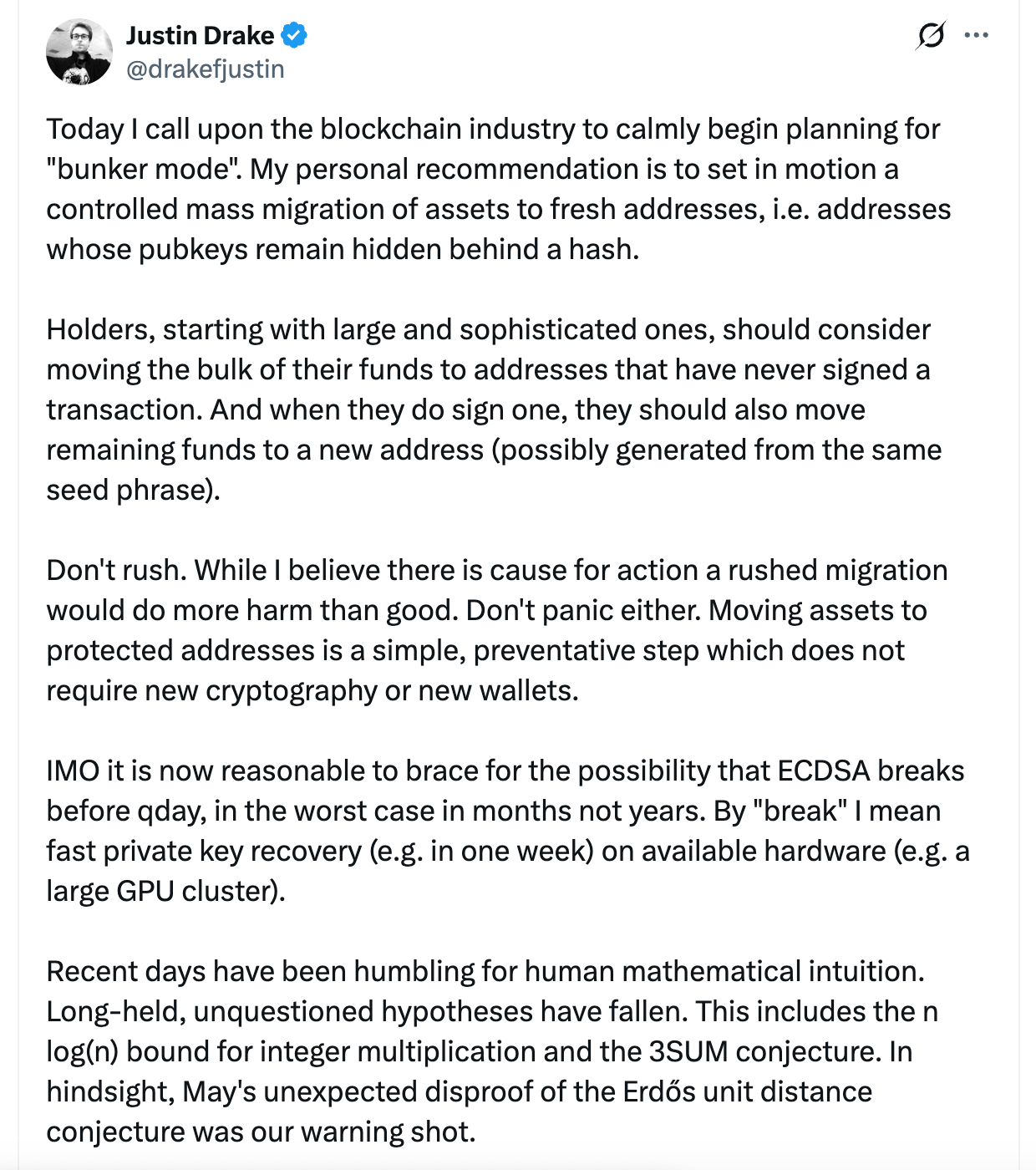
Drake’s trigger was a burst of progress in AI maths. The day before, OpenAI had released hundreds of new mathematical findings across areas like algebra and theoretical computer science. A month earlier, a team of 10,000 of its AI agents had reportedly solved a famous open problem in physics in 88 hours.
Drake’s answer was what he called “bunker mode”. Like taking shelter in a bunker until a storm passes, the idea is for crypto holders to move their funds somewhere better protected and sit tight until stronger cryptography arrives.
In practice that shelter is a fresh wallet address that has never been used to send a transaction, and therefore its public key has never been exposed (the exact logic for this I’ll explain further below).
Drake called for a controlled, gradual move of funds into these fresh addresses, and for people to move any remaining funds to a new address each time they send from an old one. He was clear that it shouldn’t be rushed though, warning that “a rushed migration would do more harm than good.”
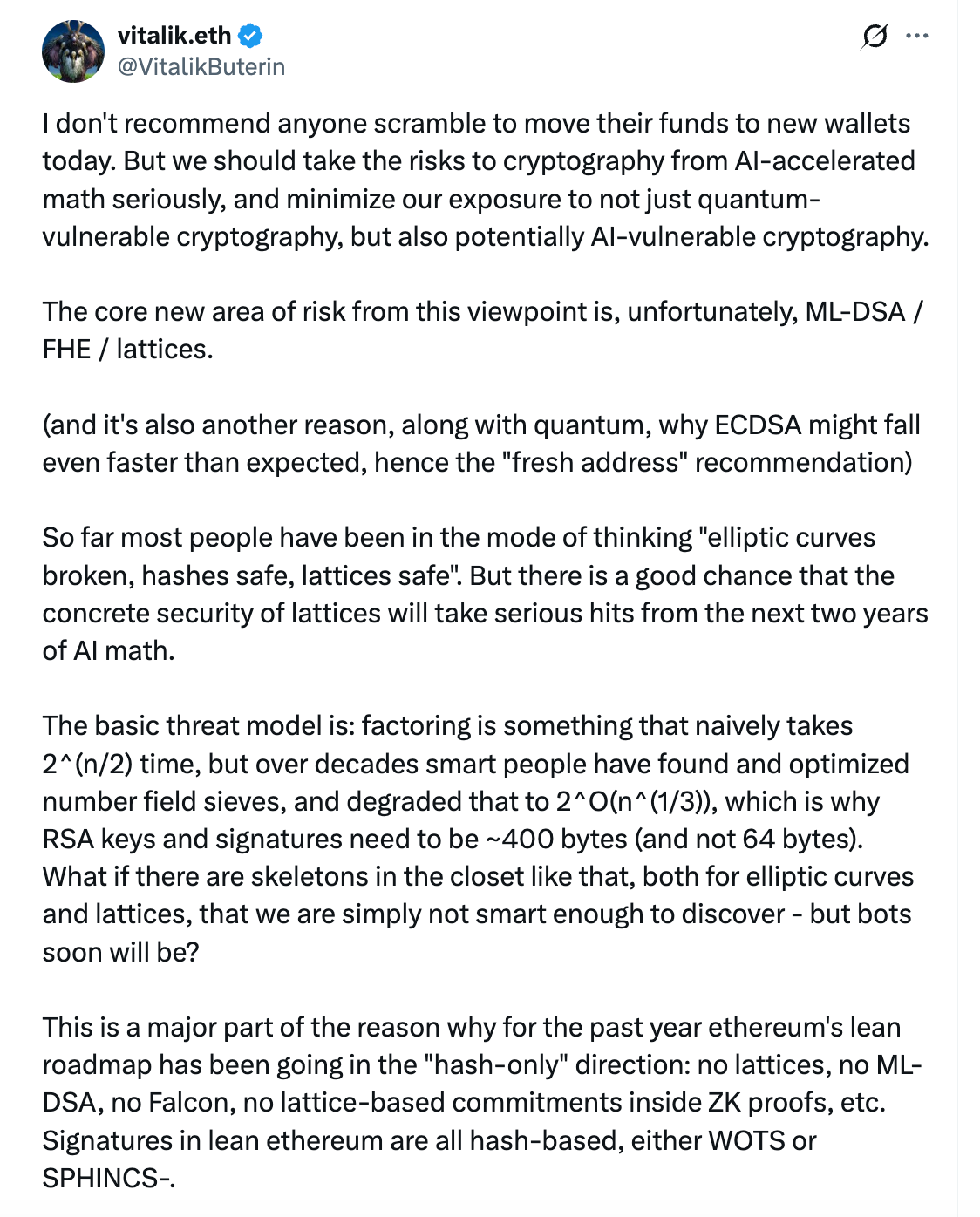
Vitalik Buterin released his own post on X supporting Drake’s post saying that he doesn’t “recommend anyone scramble to move their funds to new wallets today. But we should take the risks to cryptography from AI-accelerated math seriously.”
Others were far less worried. Yehuda Lindell, who leads cryptography at Coinbase, called Drake’s post “a really bad take”, pointing out that there’s no evidence of any weakness in maths that has held up for decades.
While, Lucien Bourdon, an analyst at hardware wallet maker Trezor, warned that a mass migration could itself become a gift for scammers.
The cryptographic maths that Drake and Vitalik are concerned about being cracked is known as elliptic curve cryptography, and it’s used to protect a user’s private keys, ie. the access to their funds!
Elliptic Curves
Every crypto wallet has a private key, a huge secret number that only you know. From it, your wallet calculates a public key using a type of maths called “elliptic curve cryptography”, and from the public key it creates your wallet address.
The whole system rests on that maths only working in one direction. Getting from a private key to a public key is easy, but going backwards is believed to be practically impossible, even for every computer on Earth working for longer than the age of the universe. I’ve discussed this before in previous posts like my Security 101.

Every time you send a transaction, you sign it with your private key, and anyone can check the signature against your public key without ever learning the secret itself. If someone found a shortcut for going backwards, they could work out private keys from public ones and sign transactions moving funds from any wallet they liked!
DeFi protocols like Aave don’t have private keys themselves, but almost everything around them does:
Your wallet, which signs every deposit and withdrawal.
The admin keys and multisigs that can upgrade protocols.
The validators that sign messages for cross-chain bridges.
It goes well beyond crypto too. The same family of cryptographic maths secures bank websites, messaging apps and most of the internet.
Your wallet address does have one additional built-in layer of protection, since it’s created by putting your public key through a “hash”, a one-way function that elliptic curve tricks don’t help with.
Your public key only gets revealed the first time you send a transaction from that address. So funds sitting at an address that has never sent anything are protected by the hash as well, which is exactly why Drake suggested moving to fresh addresses.
It’s the same point of weakness I covered in my Quantum Computers post earlier this year, where old Bitcoin addresses with exposed public keys, including Satoshi’s coins, were the most at risk.

The NIST Seeds
In 2000 NIST, the US government body that sets technology standards, published a set of elliptic curves that went on to become some of the most widely used in the world. They were built using “seed” numbers supplied by the NSA, with no explanation of where those numbers came from.
For 25 years, cryptographers wondered whether the NSA had picked those seeds to hide a secret backdoor. People launched investigations, and a bounty was eventually put up for anyone who could explain them.
On October 16th, Anthropic announced that its AI, Claude, had solved the mystery in under half an hour!
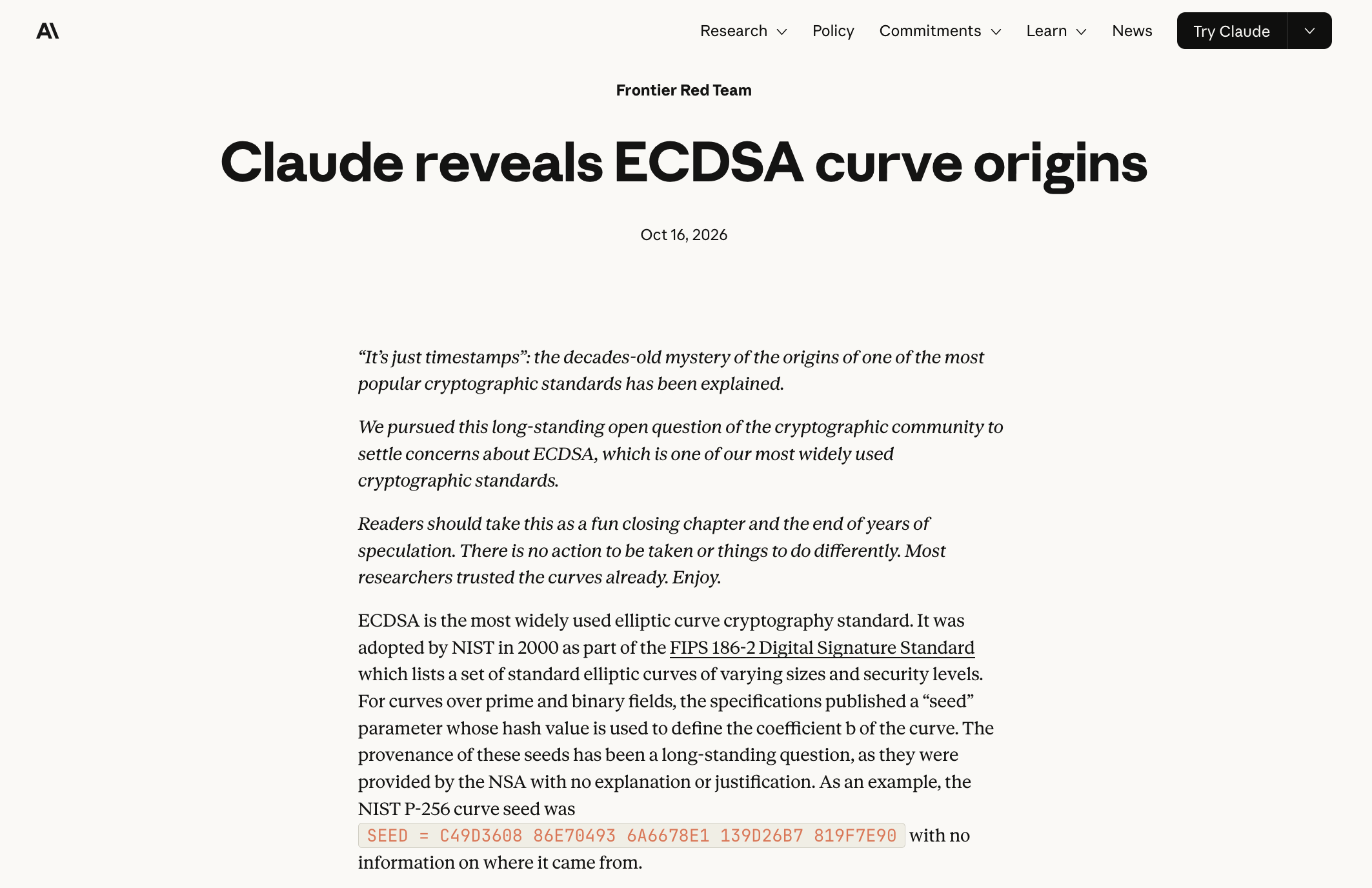
The seeds turned out to be anything but sinister. They were simply the output of a common random number generator from 1990s computers, started from the computer’s clock, and the timestamps trace back to 1997 and 1998. Anyone can now reproduce them!
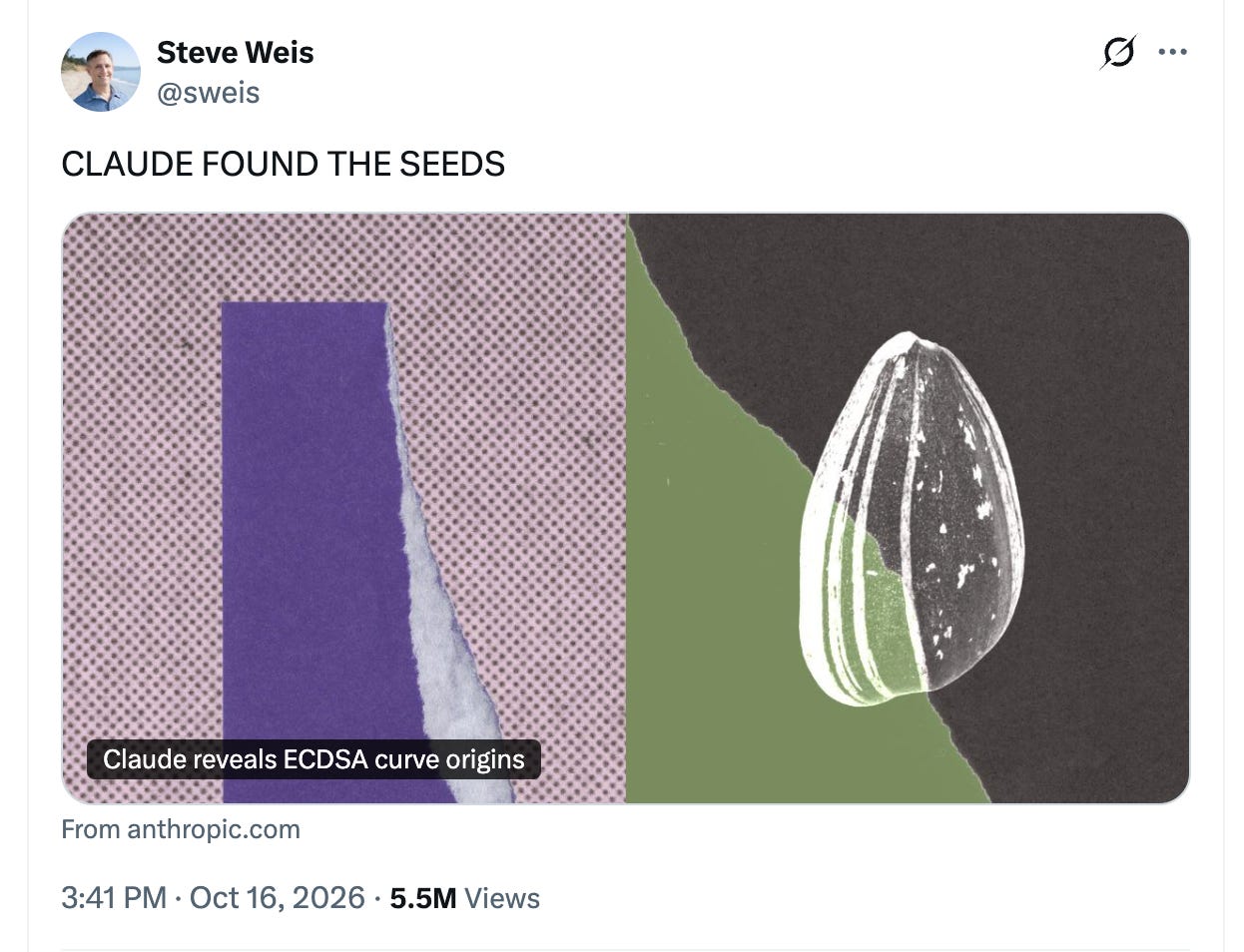
Anthropic’s conclusion was that this “makes us more confident the curves were chosen without any backdoors or intentional weaknesses.”

Bitcoin and Ethereum wallets actually use a different curve, called secp256k1, whose parameters never came with a mystery seed in the first place. So this finding doesn’t change how secure your wallet is.
But the first time AI took on a long-standing elliptic curve mystery, the result made the cryptography more trustworthy, and the same AI tools that might one day help attackers are already helping the people defending these systems.
The Fix
The fix to a break in elliptic curve cryptography already exists, and it’s the same one the industry has been building for quantum computers.
Quantum-safe signatures don’t use elliptic curves at all. So moving to them removes the risk regardless of who breaks the cryptography first, whether it’s a quantum computer, an AI, or a human mathematician. One migration covers every version of the threat!
NIST finalised its first quantum-safe signature standards back in 2024, which I covered in the Quantum Computers post. And one of them is built purely on hash functions, the most battle-tested building block in cryptography.
Vitalik also flagged that some quantum-safe schemes rely on a different kind of maths called “lattices”. He warned that “there is a good chance that the concrete security of lattices will take serious hits from the next two years of AI math.”
Meanwhile hash-based signatures don’t depend on lattices or curves, which is why Ethereum’s roadmap has been heading in what he called a “hash-only” direction.
The person leading that work is Justin Drake himself. His “Lean Ethereum” roadmap, first unveiled in July 2025, moves Ethereum to hash-based signatures, and the Ethereum Foundation set up a dedicated post-quantum team in January of this year.
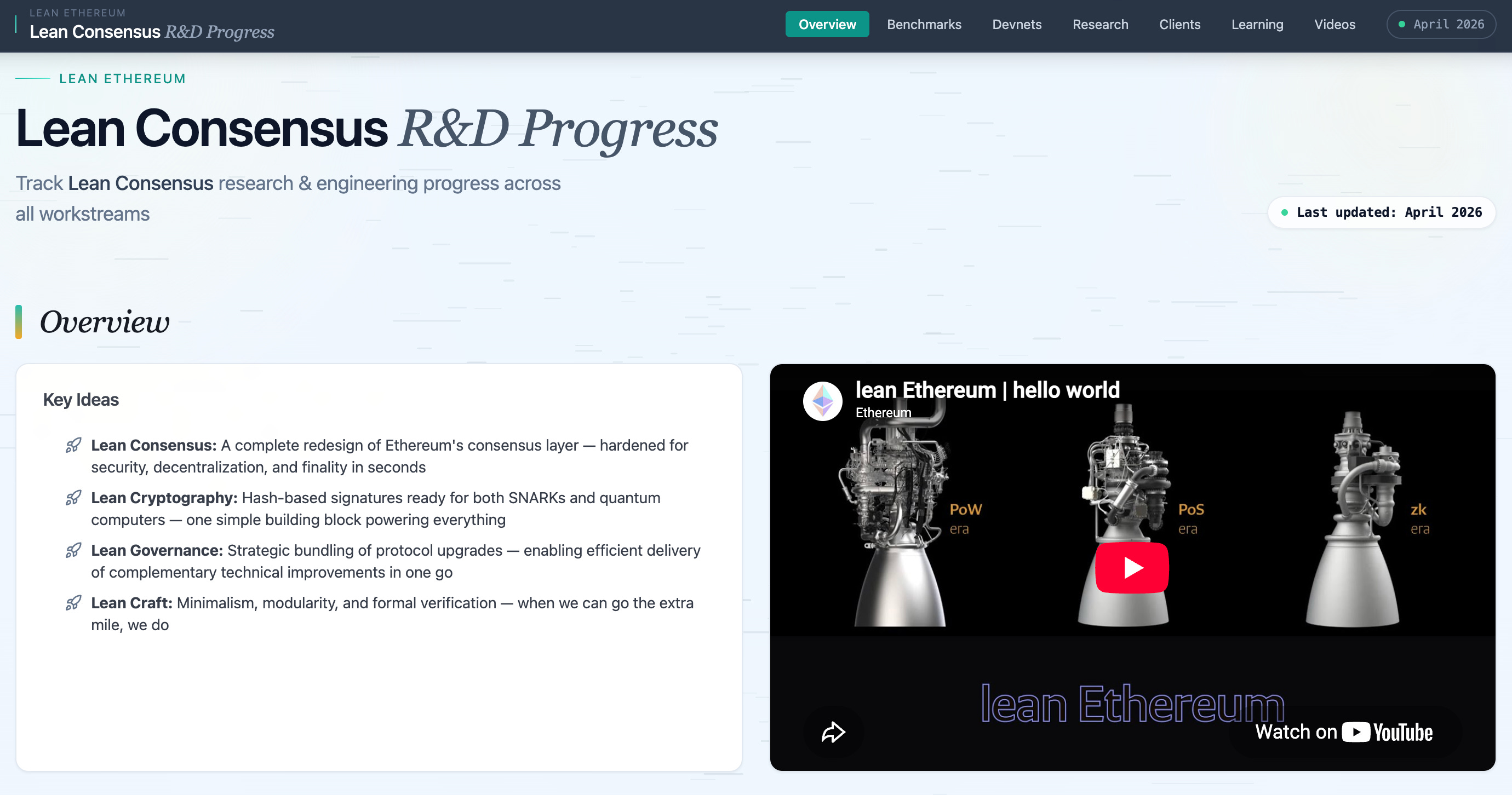
Vitalik’s long-term plan targets quantum-safe protection across the whole of Ethereum by the end of 2029. So the researcher who sounded the alarm is also building the way out!
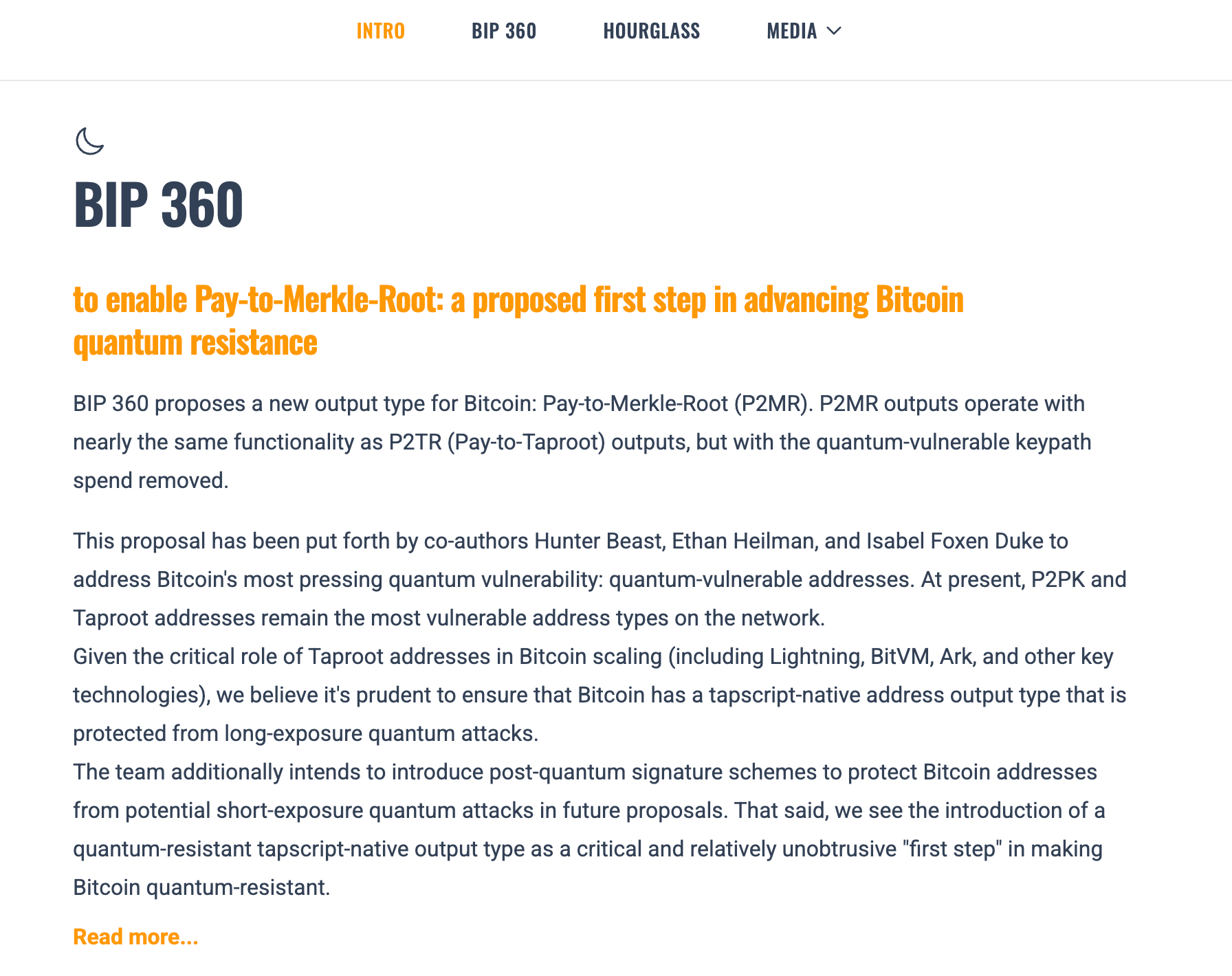
Bitcoin is moving too, although more slowly. A proposal called BIP-360 was formally added to Bitcoin’s list of improvement proposals in February, laying the groundwork for quantum-safe addresses. It’s still a draft and would need wide agreement before it’s switched on, but it’s already running on a test network.
And crypto isn’t facing this alone. Google Chrome, Apple’s iMessage and Signal have already started switching to quantum-safe encryption, and the whole internet has every reason to finish the job.
Back in 2024, Vitalik even described how Ethereum could respond to a sudden break in the worst case scenario:
The network would roll back to just before a large-scale theft and switch off ordinary transactions. People could then move their assets to new quantum-safe wallets by proving they know the seed phrase that maps onto their private key.
This works because private keys are generated from a seed phrase using hash functions, the elliptic curve cryptography part comes after that turning a private key into a public key.
So even in a sudden emergency, most users’ funds could still be saved!
Although this would be an extreme case that would cause a pretty serious halt to the blockchain and its operations, so ideally all the main blockchains will be patched before elliptic curves can be broken.
Staying Calm
So what should you actually do? For most people, very little.
If it’s easy for you, keeping your funds in an address that has never sent a transaction is a sensible habit and Vitalik himself recommends it. But there’s no need to rush, and moving funds carries its own risks. As Vitalik put it, “I personally have lost more money in botched migrations than I have lost in all hacks combined.”
Be extra wary of anyone urging you to move your crypto “for safety” too, since that’s exactly the kind of message scammers will use while this is in the news.
My personal read is that this is a real risk worth preparing for, and the industry is doing exactly that. Nothing has been broken, the fix is known, the people raising the alarm are the same people building the solution, and there’s an emergency plan if it’s ever needed sooner.
It’s the same conclusion I came to with the quantum computers post. As the tools for attacking cryptography get more powerful, so do the tools for defending it, and AI is clearly going to help on both sides.
Crypto has a habit of facing its biggest threats in public and fixing them in the open, and this looks like the next chapter of that story!

Whenever you’re ready, these are the main ways I can help you:
Want high crypto returns? Earn up to 14% APY with your own Yieldseeker agent!
Love Web3 & AI? Follow @afoxinweb3 on X for insights!
Entrepreneur using AI? Join our AI community to accelerate your results!