
TLDR:
Uniswap’s “Token Jar” is a smart contract that gathers onchain fee revenue from Uniswap and only releases it if someone burns UNI to unlock it.
The mechanism went live after the “UNIfication” vote passed Dec 25th 2025, resolving Uniswap’s longstanding “fee switch” debate in DeFi.
Robinhood Chain launched July 1st with Uniswap as its native exchange and has driven massive volume on Uniswap, accelerating new fee related proposals.
UNIfication has brought a whole new level of alignment between Uniswap labs, LPs, governance, and the UNI token with a burn mechanism baked into it all.
Robinhood chain was released at the start of this month and rapidly saw a lot of onchain activity. One of the biggest winners in all of this has been Uniswap, which has seen an explosive amount of trading volume on Robinhood’s chain.
That trading volume on Uniswap has generated a lot of revenue for them and in itself surfaced a recent yet fascinating change to how Uniswap have tied their own token and protocol revenue within their ecosystem through their UNIfication proposal - all of this is what we’ll take a look at today.
If this post resonates with you and you enjoy the content then please share it with a friend and get rewarded for doing so!

This blog goes out weekly to over 20,000 subscribers. Please message me if you’re interested in sponsorships or partnerships.
Uniswap's Token Jar
Uniswap has recently built a pretty unique mechanism to drive value to its token that hasn’t been tried before in the space. It created a novel way to burn its own token that involves what they call a “Token Jar”, which is nothing more than a smart contract where a percentage of Uniswap’s revenue gets collected into.
A token burn is usually simple: you destroy some supply and assuming token demand stays the same with this lower supply, then price should increase.
It’s a similar logic behind a company buying back its own stock. We’ve covered the basic idea of token buy backs in a post last year, where we gave the example of Aave spending $1m a week on running a buy-and-burn of its own tokens.

This is how most projects have tried to connect their revenue to their tokenomics to drive the token price upwards. Usually it’s done by sending revenue to governance, who then decide how much of it should be spent on their own buy-and-burn mechanism.
Uniswap went a level up on the idea and turned the whole mechanic on its head. Burning isn’t something governance decides to do each quarter any more, it’s now baked into how people actually get paid on the protocol, all through their Token Jar!
As I said at the top, the “Token Jar” is an immutable onchain contract, one deployed per chain, that quietly accumulates a slice of every trading fee Uniswap generates. The catch is that nobody can withdraw from it for free. The only way to claim what’s inside is to burn UNI through a second contract called the “Firepit.”
Burning works by calling Firepit’s “release()” method and naming which fee currencies you want out of the Jar in return. Anyone can trigger it, at any time, as long as they’re willing to burn UNI to do it.
As Uniswap themselves quite simply state: “Every Uniswap trade generates protocol fees. Those fees accumulate in The Jar. Anyone can burn them, permanently removing UNI from circulation.” You can see this on their website tokenjar.xyz.
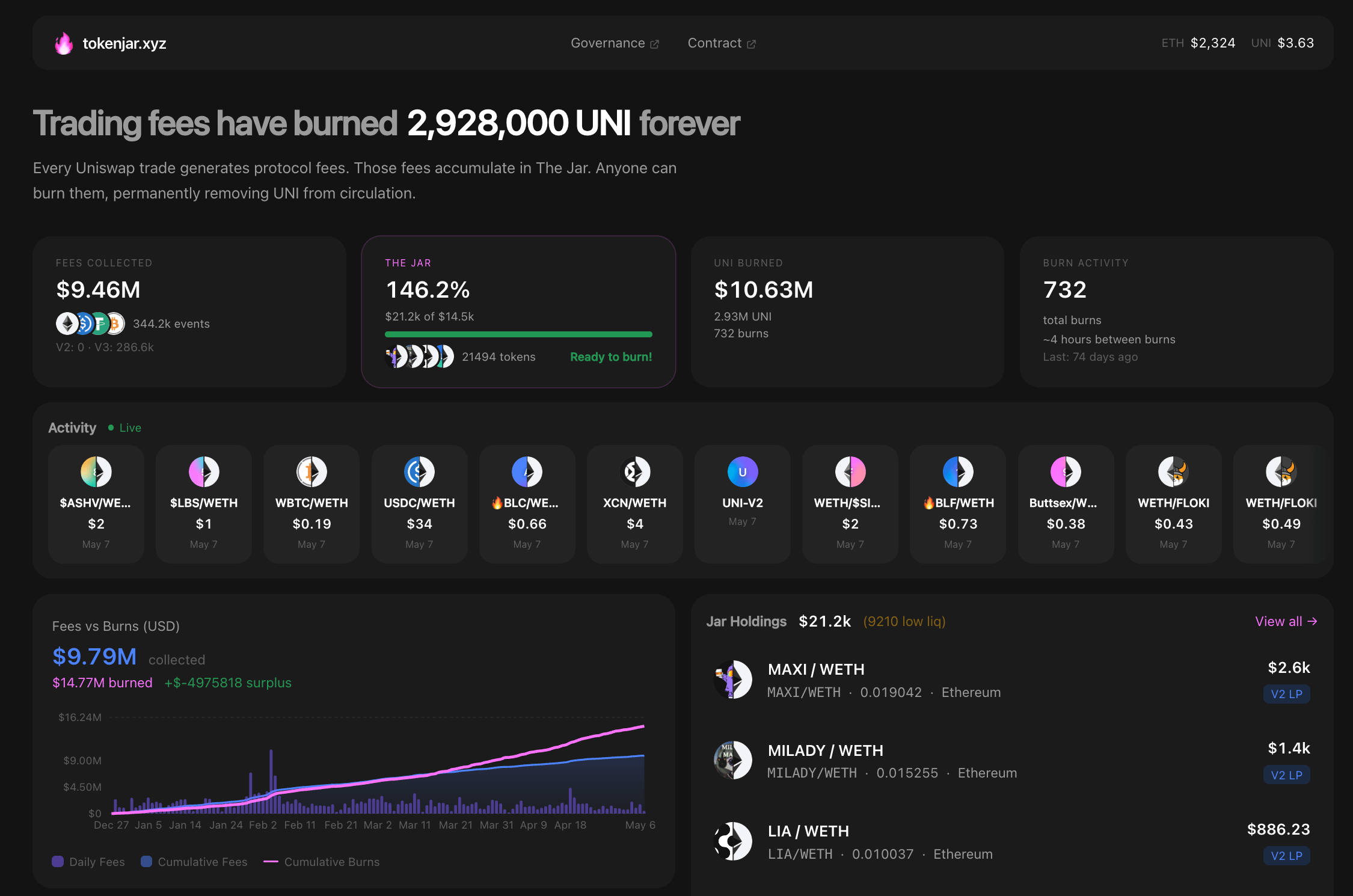
Uniswap baked token burning into the process of claiming revenue in the Token Jar, so it becomes a core mechanism, rather than what it is in most projects where governance will buy up a symbolic amount on the open market to reduce supply.
UNIfication
The “fee switch,” the idea that Uniswap’s protocol should keep a cut of trading fees instead of routing everything to liquidity providers, was one of the longest running debates in DeFi. It sat unresolved for years.
Uniswap founder Hayden Adams finally forced the question with a proposal called UNIfication. It bundled three things into one vote: turning on protocol fees; a one-time burn of 100 million UNI from treasury; and folding the Uniswap Foundation into Uniswap Labs under a single legal structure.
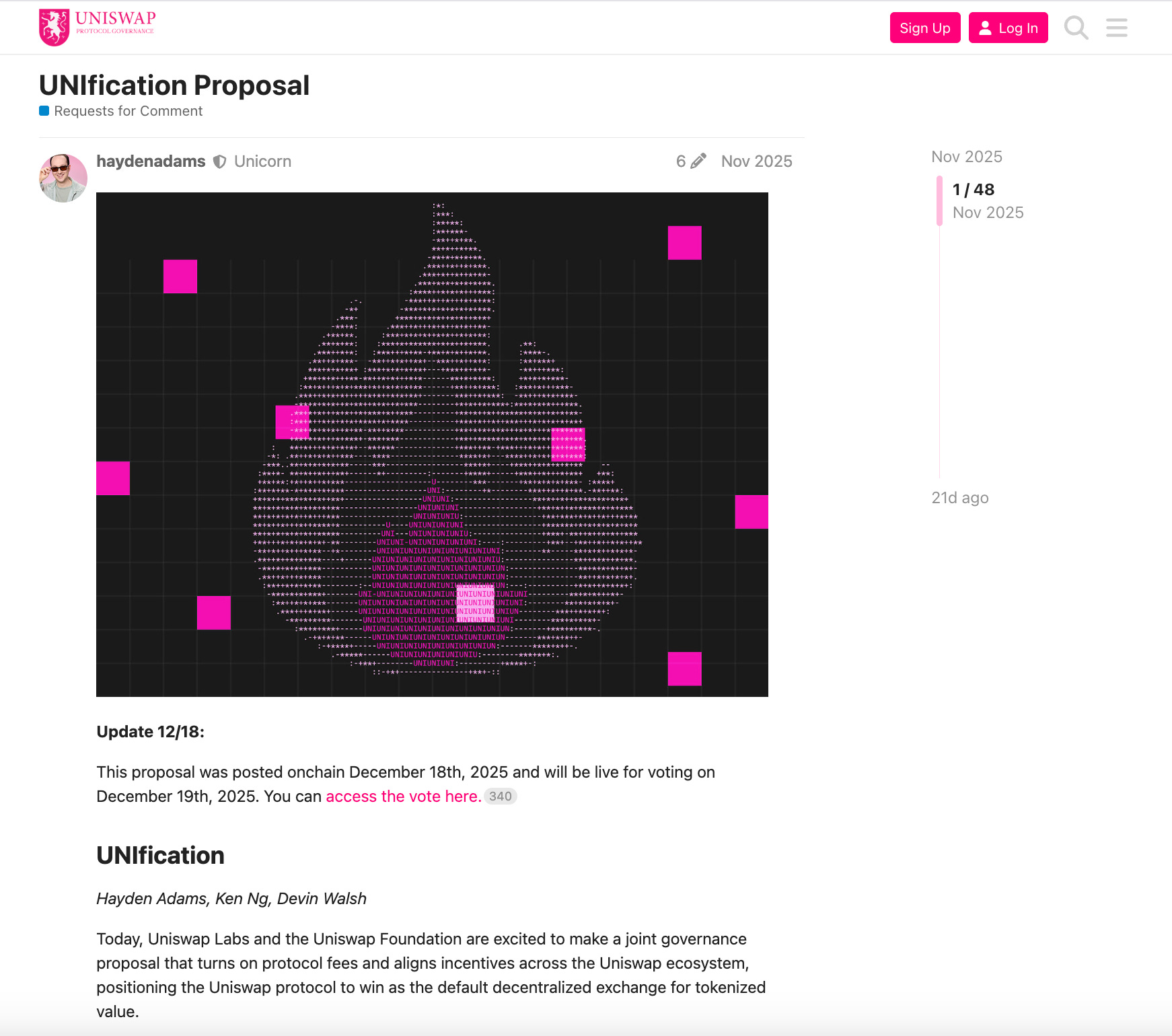
The vote concluded on December 25, 2025. It passed with 125,342,017 UNI in favour and just 742 against, comfortably past the required 40 million quorum.
The 100 million UNI burn, worth roughly $596m at the time based on UNI’s price, was framed as a retroactive correction, a simulated estimate of what the protocol would have earned had fees been switched on since Uniswap’s inception.
The fee split itself varies by version. Uniswap v2’s flat 0.3% fee became 0.25% to LPs and 0.05% to the protocol. While Uniswap v3 used a tiered cut of LP revenue instead with 25% on low-fee pools and 16.7% on higher-volatility ones. And they left v4 to figure out later.
Uniswap Labs zeroed out its own interface fees the same day. That fee used to bring in an estimated $125m a year, so it wasn’t just a small gesture. In its place, governance now pays Uniswap Labs directly with a fixed budget of 20 million UNI a year, currently around $75m, distributed quarterly from the treasury starting January 2026.
The very developers who are building Uniswap get paid in the same token everyone else is burning, so if protocol usage and burns push UNI’s value up, Uniswap Labs’ own budget is worth more too. They made a bold trade of guaranteed fee revenue towards aligning their own incentive with everyone else holding UNI.
Robinhood Chain poured fuel on the fire
Robinhood launched their own chain called Robinhood Chain at the start of this month on July 1st, as a permissionless layer 2 built on the Arbitrum stack.
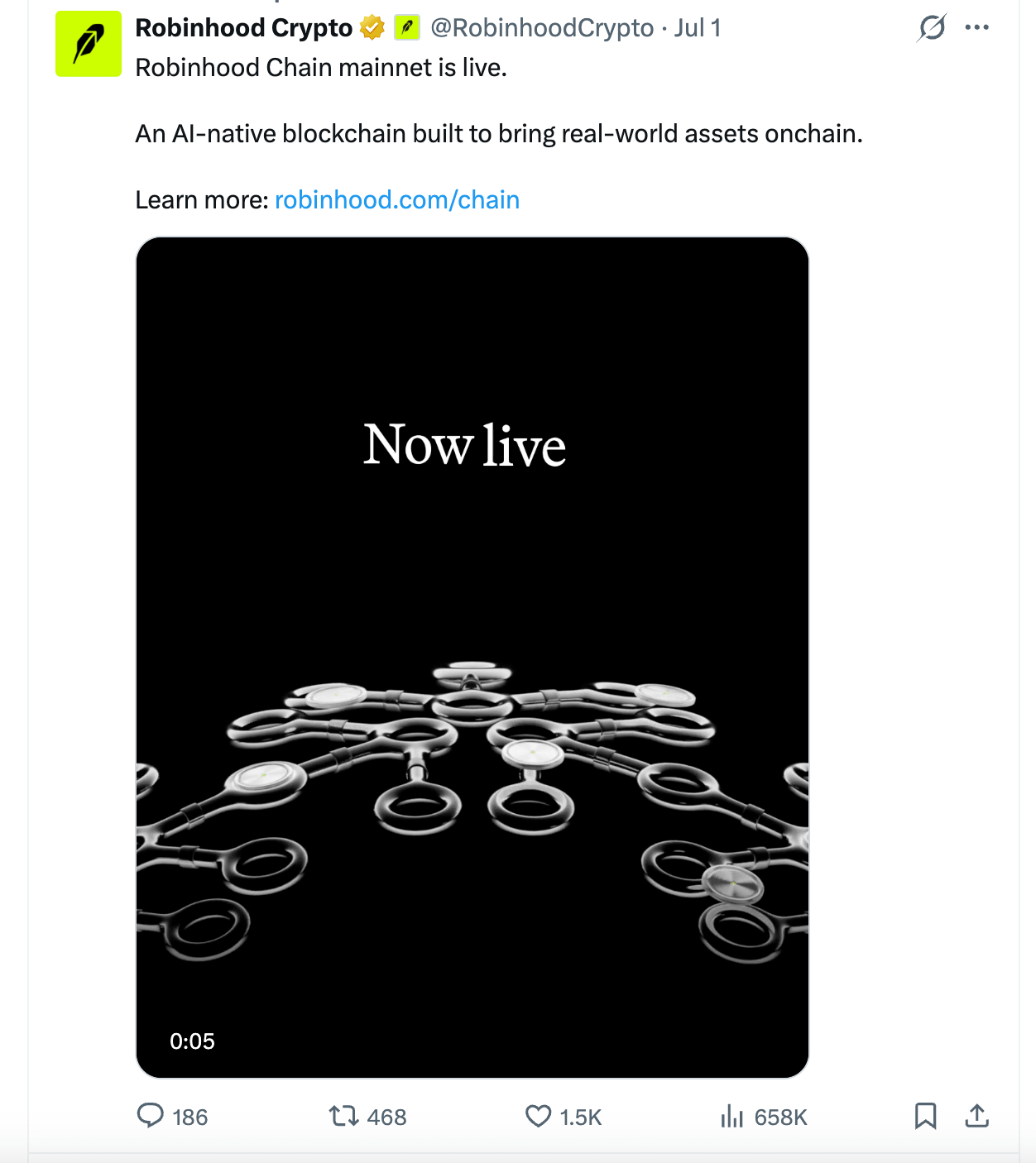
Rather than build their own DeFi building blocks from scratch, the chain launched with Uniswap and Chainlink as day-one partners. Uniswap became the chain’s native exchange by default, described as the primary venue for trading on it.
And in this short amount of time Uniswap’s deployment on Robinhood Chain has processed more than $6bn in cumulative swap volume. On July 10th it briefly surpassed Hyperliquid in daily DEX volume, with $375m traded in 24 hours.
While admittedly most of what’s driven it has been concentrated in WETH pairs and memecoin speculation, these are still very impressive numbers and the impact that it had on Uniswap’s fees was noticeable.
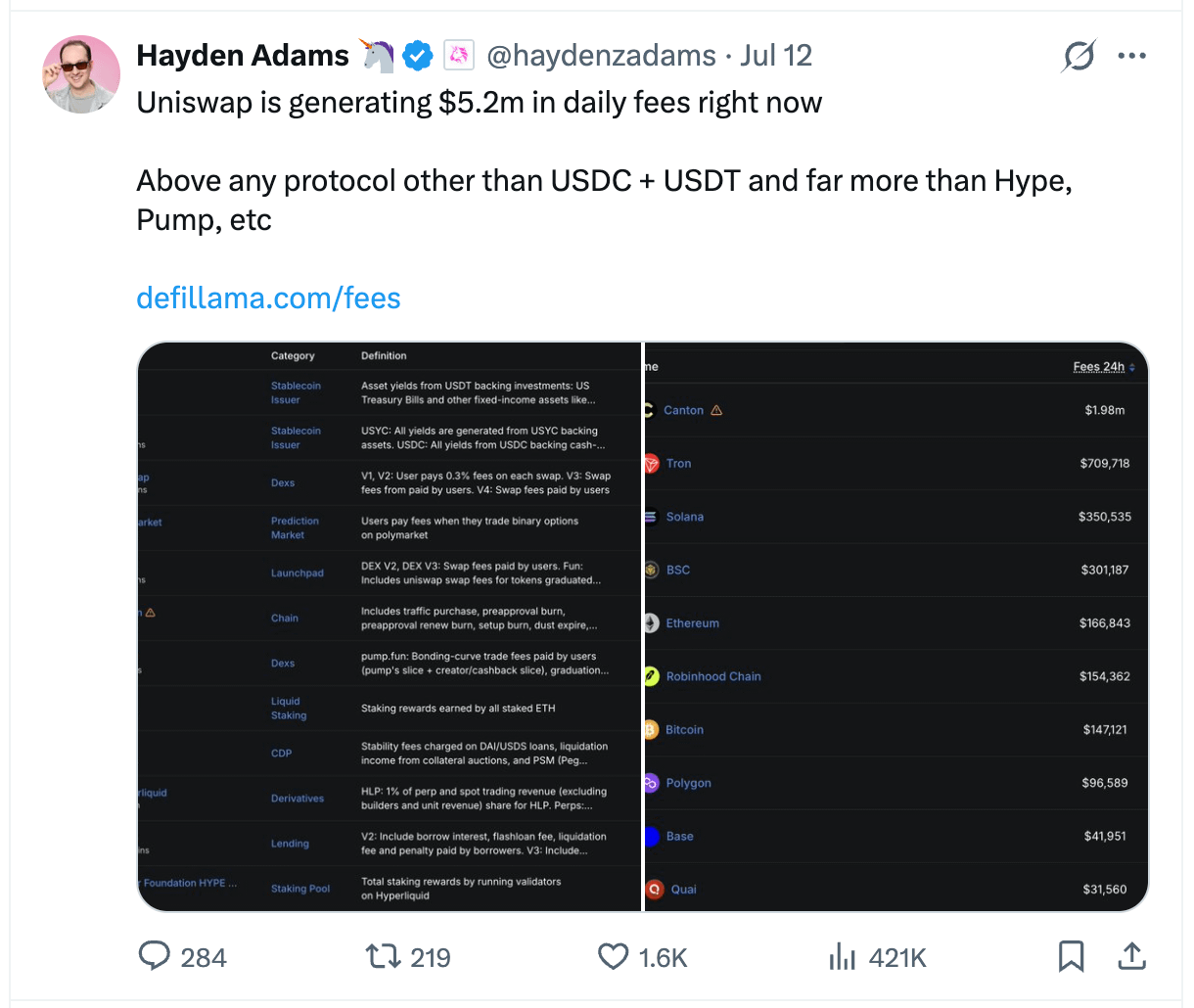
The trading volume on Robinhood Chain has been large already, and it’s barely just gotten started, you can expect that when the chain’s promised tokenised stocks start trading in large amounts then we’ll see a lot more volume on Uniswap!
The new proposal
Protocol fees are already live on 11 chains: Ethereum, Base, Arbitrum, Polygon, Optimism, BNB Chain, and more. But Robinhood Chain isn’t one of them, at least not yet. However, in response to the large volume of transactions thanks to Robinhood Chain, two new Uniswap votes were opened on July 19th.
Proposal #99 extends the same v2 and v3 fee mechanism explained above onto Robinhood Chain specifically. While Proposal #100 activates a new fee system for Uniswap v4 across seven chains at once: Ethereum, Base, Arbitrum, Optimism, Polygon, BNB Chain, and Robinhood Chain.
A follow-up vote, Part 2 of the v4 rollout, will extend v4 fees to five more chains once these initial two pass.


Hayden Adams said that: “Based on current volumes, especially Robinhood, we expect the impact on UNI burn to be substantial.” The existing system, without Robinhood Chain added yet, already burned a record 186,000 UNI in a single day last month.
Why it matters
The most interesting part of this all is the loop that’s been built underneath it all. The more chains that adopt Uniswap, more volume flows through it, more fees land in the Token Jar, more UNI gets burned, and none of it needs a fresh governance vote once a chain’s fees are switched on.
That loop isn’t guaranteed to stay favourable. When UNIfication first passed, experienced LPs warned that protocol fees compress margins and some experts predicted LPs would migrate away and leave the ecosystem entirely. This hasn’t happened yet but we’ll need to see how the competition plays out.
Still, the shift in perspective on the UNI token is hard to miss. UNI spent years being criticized as a governance token with no real claim on the value flowing through the protocol.
However, UNI now has one of the most interesting and novel mechanisms in the space with their Token Jar and is leading the charge from the front in meaningful tokenomics that aligns everyone in the ecosystem towards the token’s growing success. It’ll be exciting to see how it plays out!

Whenever you’re ready, these are the main ways I can help you:
Want high crypto returns? Earn up to 14% APY with your own Yieldseeker agent!
Love Web3 & AI? Follow @afoxinweb3 on X for insights!
Entrepreneur using AI? Join our AI community to accelerate your results!