
TLDR:
Monero is the one major cryptocurrency where every transaction is private by default, no opt-in required, unlike Zcash’s shielded pool which is optional.
Its mandatory privacy has come at a real cost: 73 exchanges delisted XMR in 2025 alone, including Binance, Kraken, and OKX, because of regulatory rules.
Monero has no company behind it at all, just volunteer developers funded through public donations, which makes its success ever more impressive.
Monero just shipped its biggest privacy upgrade ever, FCMP++, which hides every transaction among tens of millions of past outputs instead of just 16.
Last week we discussed Zcash, so I thought it would be good this week to discuss Monero as they are the two largest privacy coins in crypto.
While Monero hasn’t had a particularly meaningful event happen recently like the Orchard bug and subsequent Ironwood update that Zcash had, Monero is still one of the oldest and most important cryptocurrencies in the space, and I’ve never written about it before! So read on below to learn more about Monero, the original privacy coin.
If this post resonates with you and you enjoy the content then please share it with a friend and get rewarded for doing so!

This blog goes out weekly to over 20,000 subscribers. Please message me if you’re interested in sponsorships or partnerships.
Monero
Monero (XMR) launched in April 2014, forked from an earlier project called Bytecoin by a small group of developers, most of whom chose to stay anonymous. It is a privacy-focused cryptocurrency where the sender, receiver, and amount of every transaction are hidden by default, using cryptography built into the base protocol.
In Monero privacy is mandatory, every single transaction is private, always, there is no alternative public option. This is unlike Zcash, which lets the user choose whether to shield a transaction, as we discussed in last week’s post.

XMR currently trades at around $410, with a market cap of roughly $7.7 billion, putting it at number 13 among all crypto assets. This is right below its privacy younger brother Zcash, as the two privacy coins run almost neck and neck in market cap despite taking very different approaches to the same problem.
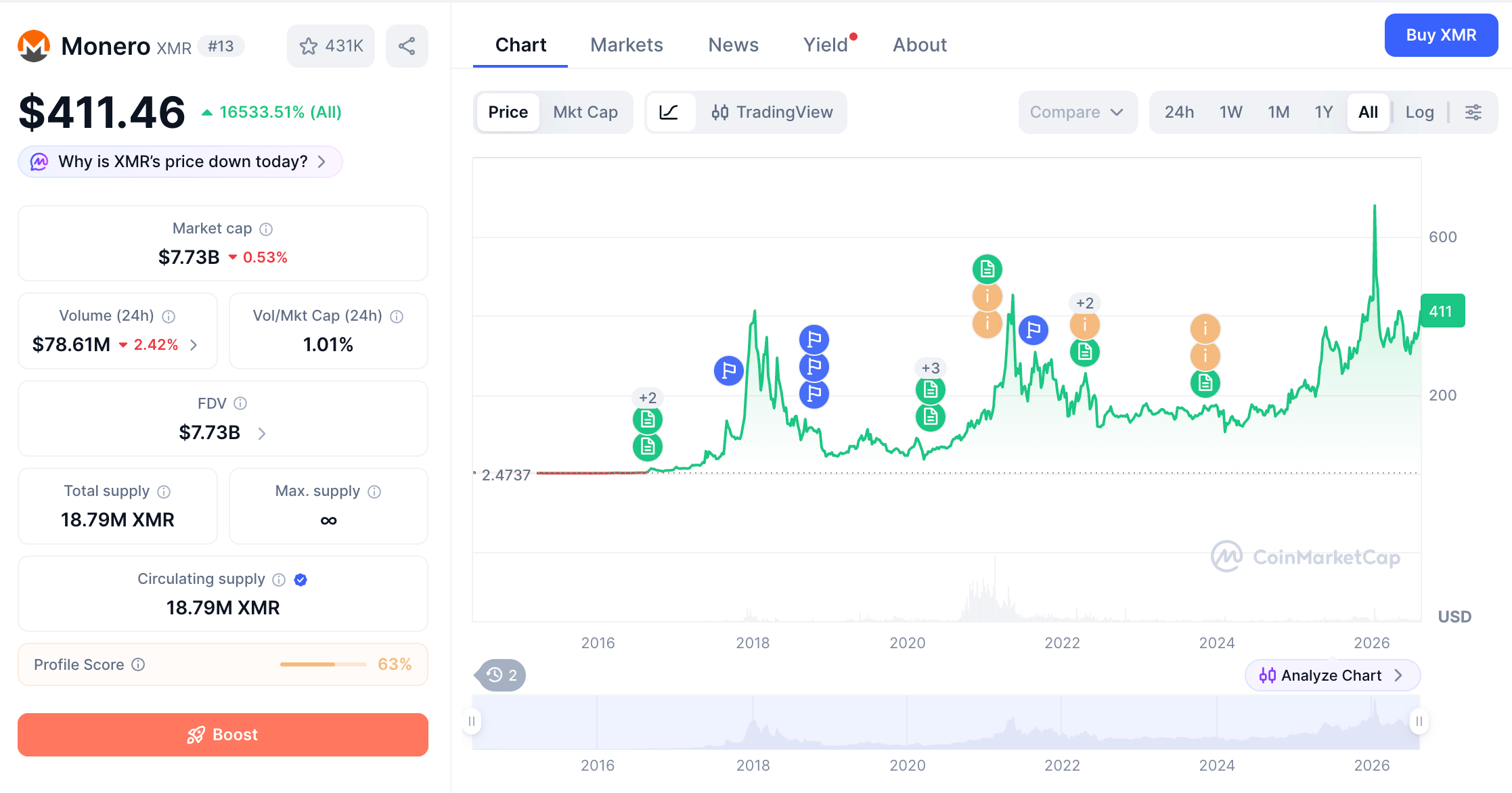
Monero’s price move itself has been choppier than Zcash’s. 2025 was a strong year with XMR growing over 126% at one point, pushing it to an all-time high of almost $800 in January 2026. It’s been a rough year since then though, with current price roughly 50% below that peak.
How Monero's privacy works
Monero’s privacy comes from three technologies stacked together on every transaction:
“Ring signatures” - mix a real transaction input with 15 decoy inputs pulled from the blockchain, so an outside observer can’t tell which of the 16 is the actual sender.
“Stealth addresses” - generate a brand new one-time address for every incoming payment, so even if you give the same public address to ten different people, no one can link those payments back together on-chain.
“RingCT” - hides the actual transaction amount using cryptographic commitments, while still letting the network verify no one’s creating money out of thin air.
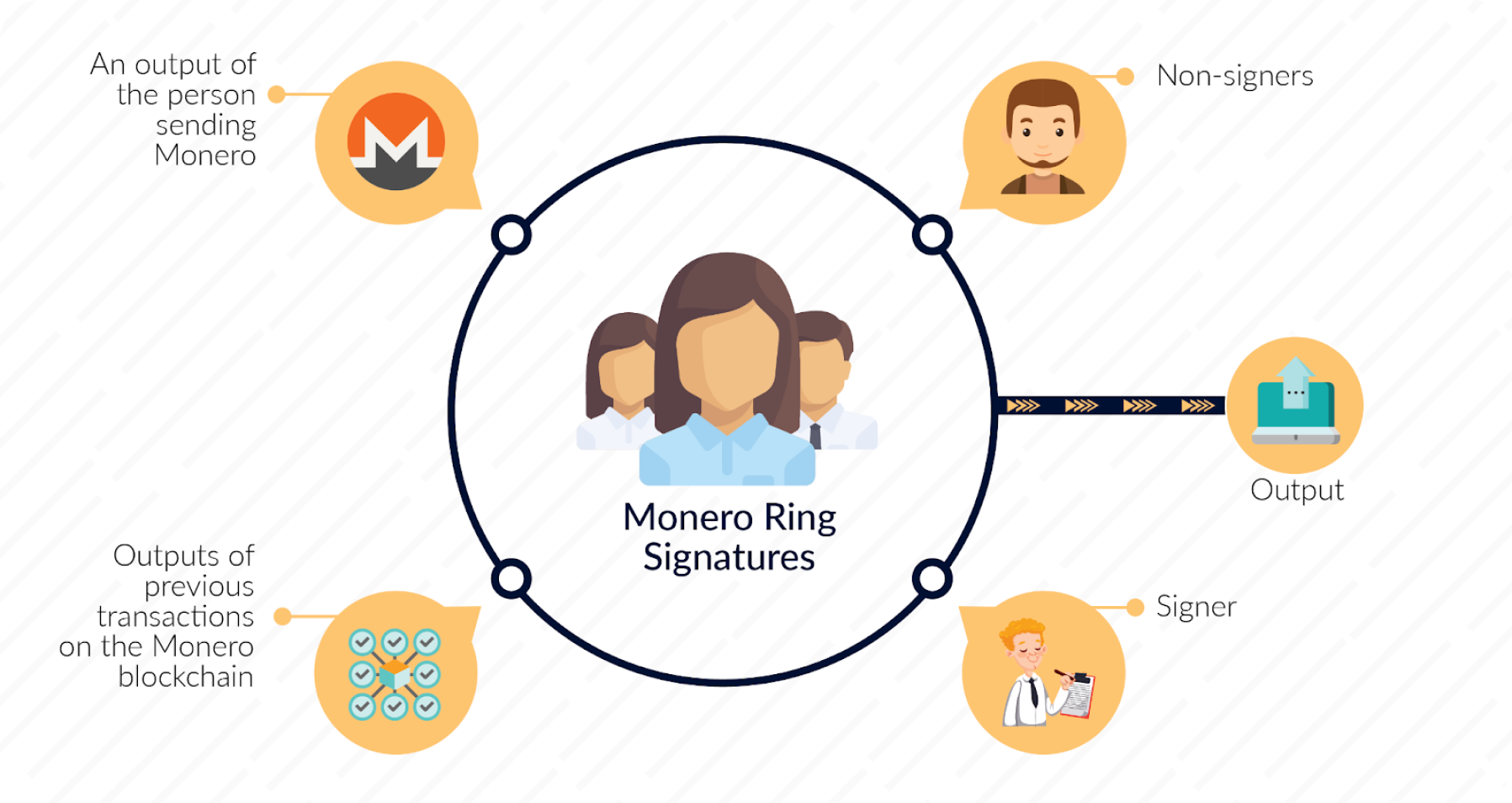
These three technologies are all crucial to how Monero acheives privacy. Each one closes a different gap that the others leave open, and there’s no transparent mode to fall back to if you’d rather skip one of them.
Ring signatures did have a real weakness though. A ring of 16 possible spenders is far better than nothing, but sophisticated chain analysis has, over the years, found ways to statistically narrow down the real input more often than a true “1 in 16” should allow.
Monero’s answer is “FCMP++”, an upgrade that activated network-wide in January 2026 and replaces ring signatures entirely with “full-chain membership proofs”.
Instead of proving a transaction’s input is one of 16 possible spenders, it proves the input belongs somewhere in the entire history of the chain, over 150 million past outputs, without revealing where. The anonymity set went from 16 to effectively the whole blockchain, and the proofs themselves stay compact at only 3-4 KB each.
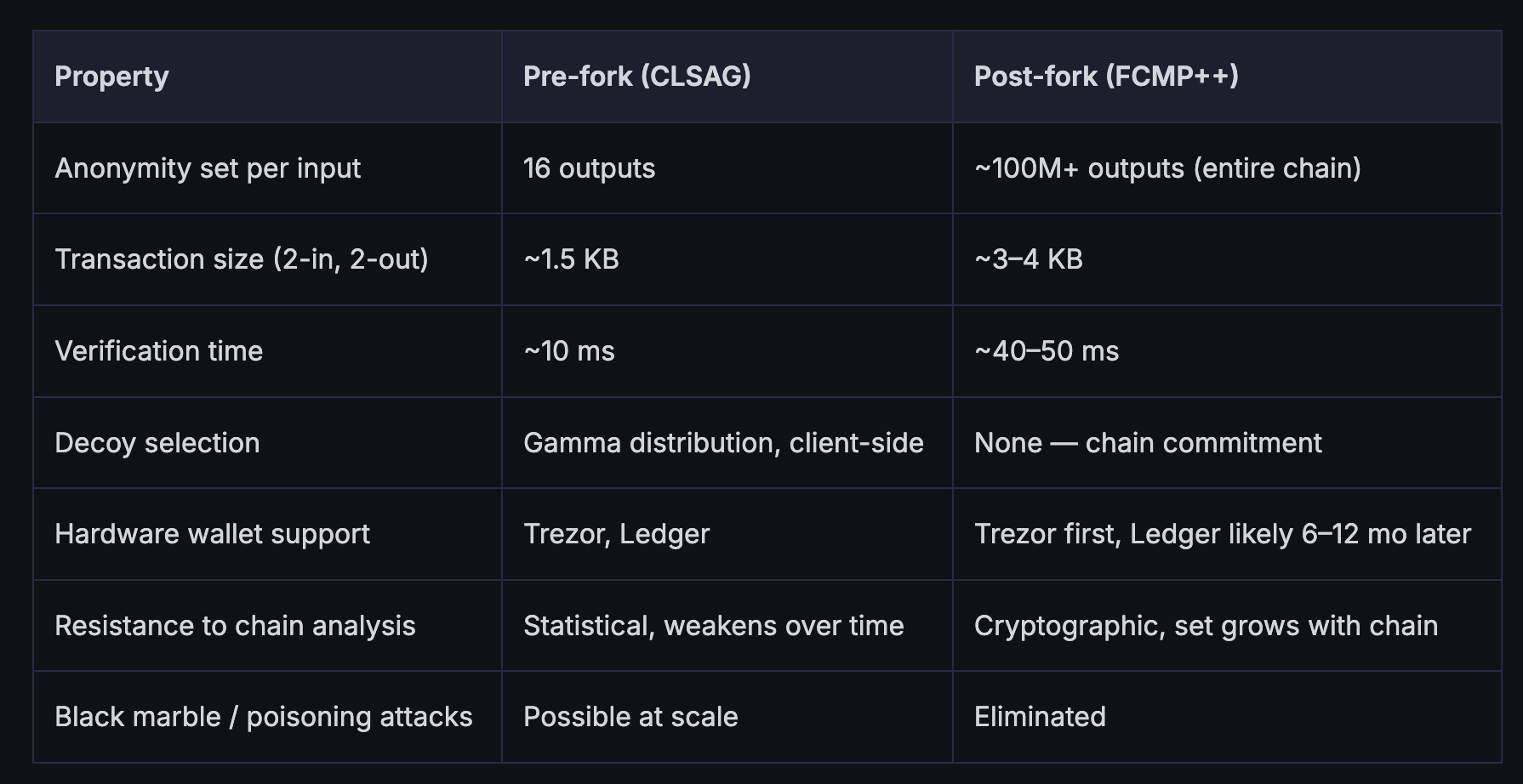
Meanwhile Monero’s mining algorithm uses “RandomX”, a proof-of-work algorithm specifically tuned to run efficiently on ordinary computer CPUs. The goal was to resist the kind of specialized mining hardware that ends up concentrating power in a few large mining operations as we see on other networks like Bitcoin.
Mandatory privacy has a real cost
Zcash’s optional shielding that we discussed last week is exactly what’s let it stay listed on major exchanges. Monero’s mandatory version hasn’t had the same luck.
OKX dropped XMR trading pairs in January 2024. Binance delisted it globally the following month, February 2024. Kraken pulled it from Ireland and Belgium in mid-2024, then across the entire European Economic Area by October 2024. While Huobi had already started phasing out privacy coins back in September 2022.
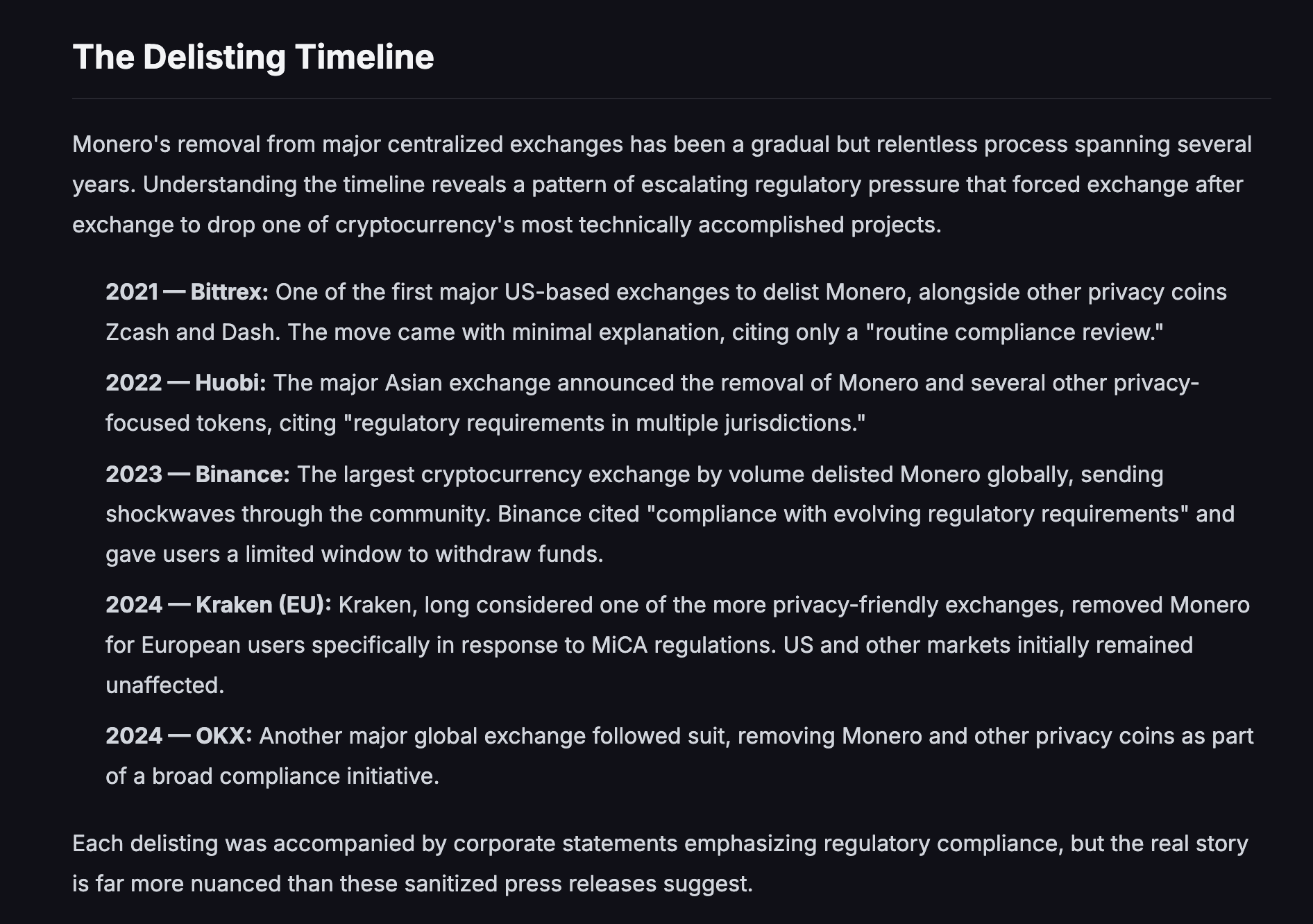
By 2025 the pace had picked up further, roughly 73 exchanges removed Monero that year alone, including Coinbase and Bitstamp.
It’s not just because “regulators don’t like privacy coins.” The EU’s MiCA framework, along with similar rules in other jurisdictions, effectively requires crypto platforms to be able to monitor transactions to comply with the FATF’s “travel rule”, tracking who’s sending funds to whom above certain thresholds.
A coin where every transaction is unconditionally hidden makes that kind of compliance literally impossible. There’s no transparent fallback the way there is with Zcash, so exchanges in regulated markets have mostly just removed it instead.
Importantly though, owning Monero is still completely legal in many places including US, EU, UK, and Canada. Delisting is due to exchanges making their own compliance decisions, not a government ban on the asset. And usage hasn’t collapsed alongside the delistings, as P2P and decentralized trading volumes have held up strong.

Moreover, people have also tried to crack Monero’s privacy for years. CipherTrace has publicly advertised “enhanced Monero tracing capabilities” for governments since 2020, and the IRS has paid firms including Chainalysis and Integra FEC more than $1 million combined to build Monero “attribution tools.”
However, these are probabilistic models built from exchange records, IP metadata, and wallet seizures, not a way to break the cryptography. No analytics firm has published a way to actually decrypt Monero’s on-chain data, and the IRS’s original bounty for cracking Monero outright from 2020, has never been fully claimed.
Nobody's actually in charge
Monero has no company behind it. No Electric Coin Co or ZODL equivalent as in Zcash, no board, no CEO. Development happens through a loose, largely pseudonymous group of volunteer contributors, the same anonymous-by-default structure the project launched with back in 2014 and that hasn’t really changed since!
So how does real engineering work actually get paid for without a company?
The answer is their Community Crowdfunding System (CCS), a public forum where anyone can propose a piece of work and the community funds it directly in XMR.

The CCS raised roughly $925,000 in 2025 alone, funding things like wallet development and network-privacy research. Payment sits in escrow and only get released once the work is actually delivered. There’s no venture funding, no token sale, no company payroll sitting underneath any of it.
This structure cuts both ways. There’s no single entity to subpoena, pressure, or have a governance dispute with. But there’s also no one who can ship a fix fast when something goes wrong, decisions and funding both move at the speed of community consensus, for better and for worse.
That trade-off got a live test in 2025 when a mining pool called Qubic, linked to former IOTA co-founder Sergey Ivancheglo, grew to roughly a quarter of Monero’s total hashrate by mid-2025 and publicly claimed outright majority control in August.
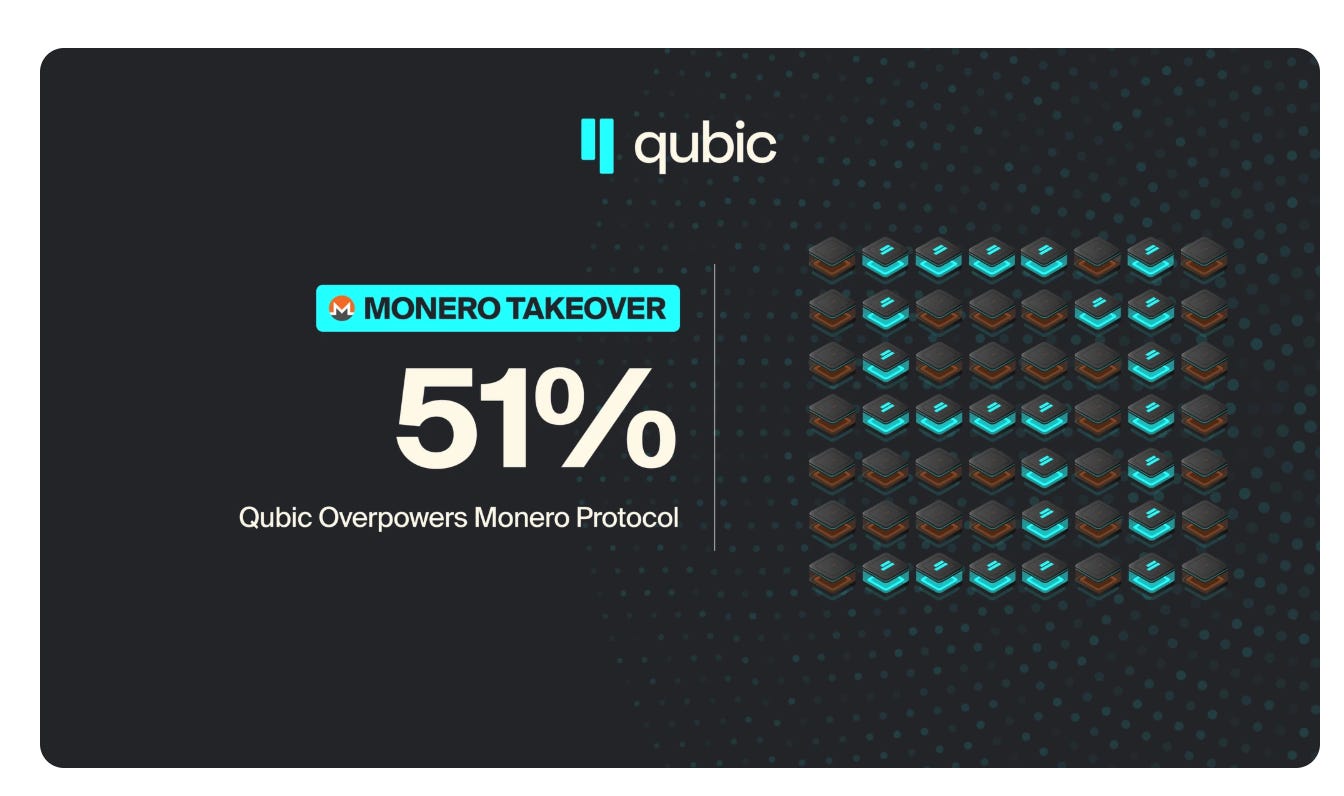
With no company or foundation to coordinate an emergency response, it fell to the miners themselves who organized an informal boycott of Qubic’s pool that brought its share back down within about a month. No funds were ever stolen or anything remotely similar.
The market’s own reaction was clear too, XMR dipped on the initial announcement, then actually went back up once the reorganisation played out without causing any losses, a sign that the ecosystem considered Monero’s promise stronger than ever.
All of this means that Monero is a genuinely different bet than Zcash. There’s no company to trust or distrust, but also no company to hold accountable, or to move fast when something needs fixing.
Monero’s harder privacy
Monero remains the most technically rigorous privacy option in crypto. The FCMP++ update in January of this year pushed its anonymity guarantees further than any privacy coin has gone, and no analytics firm has ever demonstrated it can actually break the underlying cryptography.
But 2026 has genuinely been a harder year to hold that position in practice. XMR sits roughly 50% below its January peak, its decentralised mining model recently went through a real stress test via the Qubic episode, and the wave of exchange delistings shows no signs of reversing.
Monero bet everything on mandatory, uncompromising privacy and the purest version of the technology, while Zcash bet on an optional version that plays nicer with regulators and exchanges.
Monero is the harder technical purist’s choice, while Zcash is the more pragmatic one. This year has been a decent real-world test of which trade-off actually wins out over time as Zcash has shot ahead, but it’s still too early to draw any real conclusions.
Whether Monero’s technical edge is enough to outweigh the accessibility it keeps losing, or whether Zcash’s more compromising approach is the one that actually lasts, is something to keep a keen eye on in the ongoing battle for privacy coin supremacy.

Whenever you’re ready, these are the main ways I can help you:
Want high crypto returns? Earn up to 14% APY with your own Yieldseeker agent!
Love Web3 & AI? Follow @afoxinweb3 on X for insights!
Entrepreneur using AI? Join our AI community to accelerate your results!