
TLDR:
A zero-knowledge proof lets you prove something to be true without revealing the information itself, like proving you’re over 18 without showing your passport.
ZK proofs have become a key part of crypto infrastructure as their properties are very helpful both in scaling and privacy.
Zcash pioneered ZK privacy in crypto back in 2016, and projects like Aztec Network are now bringing it to Ethereum making private DeFi possible.
ZK technology may ultimately solve the Blockchain Trilemma, allowing Ethereum to scale without sacrificing security or decentralisation.
In keeping with my recent privacy theme, I decided to write about ZK Proofs this week which have become a core piece of cryptographic technology in the Web3/Crypto space.
ZK Proofs are complex mathematical constructs that allow you to prove something to be true, without revealing what it is. This may not sound clear at all at first, but once the concept clicks it’s utility and importance becomes very clear as you’ll see below.
If this post resonates with you and you enjoy the content then please share it with a friend and get rewarded for doing so!

This blog goes out weekly to over 20,000 subscribers. Please message me if you’re interested in sponsorships or partnerships.
Zero Knowledge Proofs
Most people in crypto will have heard the term “zero-knowledge proof” or ZK proof thrown around, usually in the context of scaling solutions or privacy, but may not know what it really means.
It sounds like deep cryptography, and technically it is, but the core idea is surprisingly intuitive to understand once you have the right framing. And given how central ZK technology has become to where crypto is heading, it’s worth understanding it properly.
At its core a ZK proof is a way of proving you know something to be true without revealing the information itself.
That sounds abstract, so here’s a few concrete examples :
You want to prove you’re over 18 without handing over your passport.
You want to prove you have enough funds for a transaction without revealing your balance.
You want to prove you solved a puzzle correctly without showing the solution.
In each case, you’re convincing someone the fact is true while giving them zero additional information beyond the fact itself. That’s the “zero knowledge” part.
The concept has existed in academic cryptography since the 1980s, but it’s only in the last few years that the technology has become fast and cheap enough to be practical at scale.
How ZK proofs work
There are two parties in any ZK proof: a “prover” and a “verifier.”
The prover knows some data X and wants to convince the verifier about some property it has without revealing what X is. Let’s say that X is the age on their passport and they want to convince the verifier they are over 18 years old.
To do that, a cryptographer/developer creates a mathematical computation known as a "circuit", we'll call C, that encodes the claim to be proved of being over 18 years old. This circuit C is then shared with both the prover and the verifier.
The prover then runs C with X to produce a short piece of data called a "proof", we'll call Z, that proves they are older than 18. Here we have something mathematically along the lines of C(X) = Z.
The prover then hands over Z to the verifier, and with both Z and C in hand the verifier can check this proof quickly and cheaply and if it passes, they know the prover's claim that they are older than 18 is true - all without the verifier ever having received the prover’s age X!
The underlying math is worth a brief mention without getting into too much detail. These encoded “circuits” use polynomial equations under the hood because of a key property that two polynomial equations will practically only ever agree on a randomly chosen result if they are ultimately the same polynomial.
So in this process you get a logical statement like age X > 18, mapped onto complex polynomial equations, then a single check of that equation at a secretly pre-defined value to see if the prover and verifier are looking at the same equation, and if they are then for all intents and purposes they are both agreeing on the same information.
Meaning that ultimately you get this potentially massive computation reduced to a single and simple check.
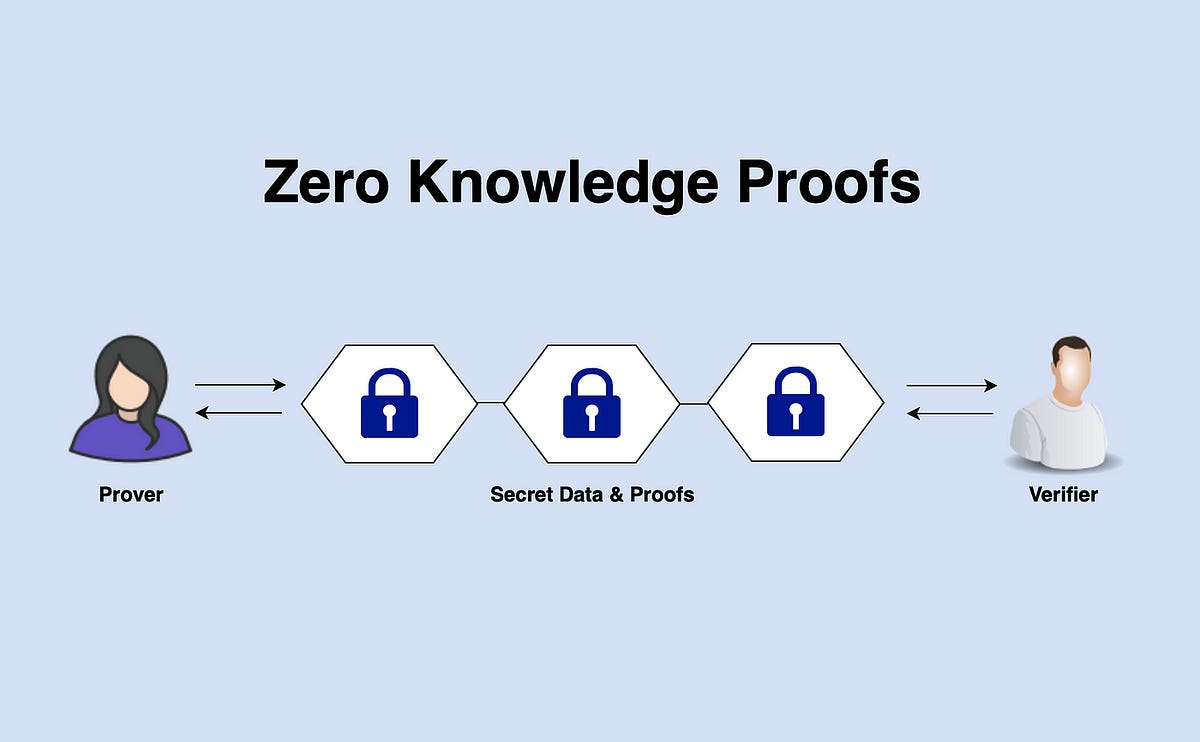
The key property of ZK proofs is this asymmetry: generating a proof is computationally heavy, but verifying one is fast and cheap.
This might sound like a limitation, but it’s actually what makes ZK proofs so powerful in practice. The hard work happens once, off to the side, and the result can be verified by anyone almost instantly.
There’s a parallel here to how Proof of Work functions in mining where it requires a lot of work to get a correct hash to mine a block, but once you’ve found the answer it’s easy to prove. Though unlike PoW, in ZK the work happens privately and reveals nothing about the inputs!
Where they show up in crypto
As ZK proof technology has become cheaper to use, it’s grown in importance in the space. One of the biggest use case today is “ZK rollups” for Layer 2’s.
The core problem ZK rollups solve is that Ethereum’s mainnet is slow and expensive to use directly. Rollups process transactions off-chain in large batches, then submit a ZK proof to Ethereum proving that every single transaction in that batch was valid.
Ethereum verifies the proof, which is small and cheap, rather than re-executing every transaction itself. You get the throughput of an off-chain system with the security guarantees of Ethereum underneath it.
The major ZK rollups running today include zkSync Era, StarkNet, Polygon zkEVM, Linea, and Scroll. If you’ve used any of these, you’ve been relying on ZK proofs with every transaction.
As a next step the Ethereum Foundation is now focused on trying to get ZK technology to be used directly on the Ethereum base layer so that it can scale transaction throughput without needing these L2 blockchains.

Beyond scaling, ZK proofs have a second major application: privacy. If you can prove some property about a data point X without ever revealing X then it naturally lends itself well to privacy.
Zcash, which launched in 2016, was the first cryptocurrency to use ZK proofs for their shielded transactions. In this case they specifically used zk-SNARKs, a type of ZK proof that produces very small, fast-to-verify proofs.
A shielded transaction proves that a payment is valid (the amounts add up, the sender has the funds) without revealing the sender, receiver, or amount to anyone watching the chain. It was the first real proof that ZK privacy worked in practice.
The same idea is now coming to Ethereum. Aztec Network is building ZK-based privacy infrastructure that lets users transact, lend, and interact with DeFi protocols without exposing their positions publicly.
The goal is private DeFi: getting the composability and yield of Ethereum without broadcasting your entire financial activity on a public ledger.
ZK proofs are also being applied to identity, where they can prove things like KYC completion or proof of personhood without exposing any underlying documents. Worldcoin uses ZK proofs for exactly this by proving you’re a unique human without revealing who you are.
Why it matters
Before ZK proofs scaling Ethereum without compromising its security was an unsolved problem. This known as the infamous “Blockchain Trilemma”, which says that you cannot have all 3 of security, scalability and decentralisation.
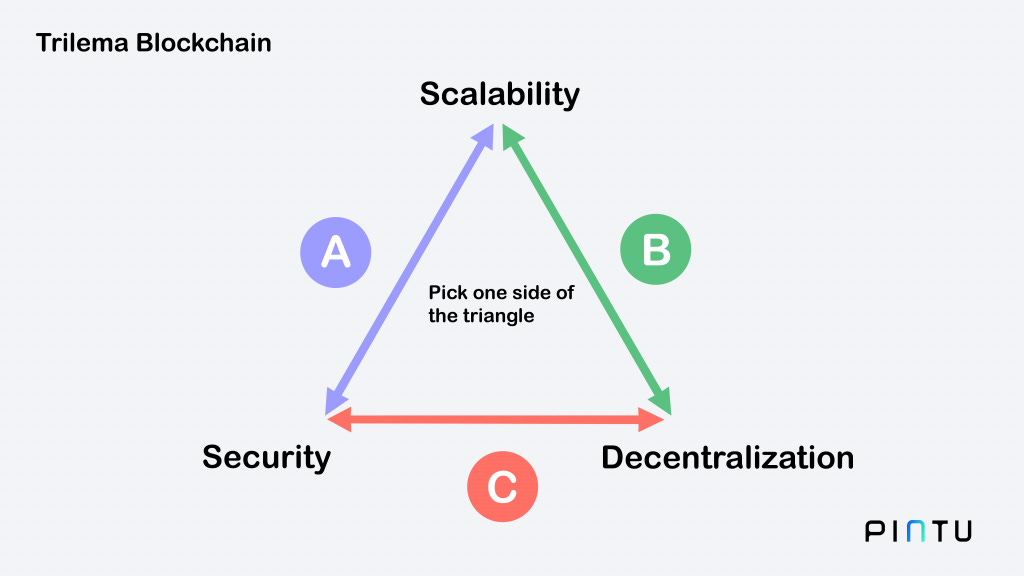
However, ZK proof technology is beginning to change things and making it look like the Ethereum mainnet will be able to scale while remaining secure and decentralised!
Ethereum’s long-term roadmap leans heavily on this. Researchers have described a future state, sometimes called “the Ethereum endgame,” where ZK proofs allow Ethereum to verify its own entire history efficiently, making it possible to run a full node on consumer hardware.
Earlier this year Vitalik himself even said that “The trilemma has been solved - not on paper, but with live running code”.

The privacy application matters for a reason that doesn't get discussed enough: public blockchains are radically transparent by default. Every transaction, every position, every wallet balance is visible to anyone who looks.
That's fine for individual users comfortable with it, but it's a real barrier for businesses and institutions who have no interest in broadcasting their treasury movements or trading activity to competitors.
ZK-based privacy doesn't obscure transactions through obfuscation, it proves validity cryptographically while revealing nothing else. This a fundamentally different and more robust kind of privacy, and it could unlock a layer of DeFi participation that currently doesn't happen.
The identity and credential use case is also worth watching. A lot of the friction in crypto KYC processes, proof of residency, accredited investor checks all involve handing over far more information than the verifier actually needs.
ZK proofs could change that fundamentally, replacing documents with cryptographic proofs that reveal only what’s necessary.
The future is ZK
If you’re using zkSync, StarkNet or ZCash already, you’re further into the ZK future than most people realise. The technology is not experimental any more, it’s processing real and meaningful volume daily.
For most users the practical near-term implications are lower fees and faster withdrawals on ZK-rollups compared to optimistic rollups.
Longer term, ZK-powered privacy tools will make it possible to participate in DeFi without broadcasting your entire financial position to anyone watching the chain.
Plus there’s a very real possibility that it’ll help solve the blockchain trilemma in such a way that the Ethereum base layer will scale while remaining secure and decentralised!
ZK proofs are one of those things that started as a theoretical curiosity and quietly became foundational crypto infrastructure, and now you know what they are, how they work and why they are such an important part of the future of the Web3 and crypto space!

Whenever you’re ready, these are the main ways I can help you:
Want high crypto returns? Earn up to 14% APY with your own Yieldseeker agent!
Love Web3 & AI? Follow @afoxinweb3 on X for insights!
Entrepreneur using AI? Join our AI community to accelerate your results!